
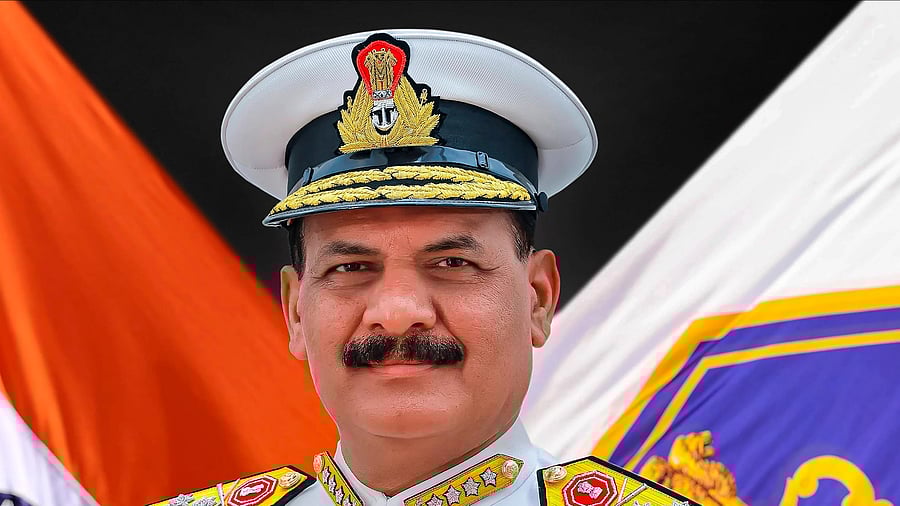
Chief of the Naval Staff Admiral Dinesh Kumar Tripathi.
Credit: PTI photo
New Delhi: Threats that were once considered “low end” currently display tactics and unleash firepowers associated only with states, necessitating all Indian warships outfitted to the maximum extent possible to be ready for combat all the time, Chief of the Naval Staff Admiral Dinesh Tripathi said on Sunday.
"The non-traditional threat spectrum now involves weapons, tactics, and intent that mirror state-level conflicts. This necessitates all Indian units proceeding to sea to be outfitted for combat to the extent feasible while being prepared for constabulary and marine roles,” he said, delivering Admiral JG Nadkarni memorial lecture a lecture in Pune.
Also since conflicts happen nowadays without prior notice, the need is to be in a constant-ready paradigm.
“Op Sindoor demonstrated Indian Navy’s constant-readiness posture, wherein the swift deployment of our platforms, conduct of multiple weapon firings within 96 hours, aggressive manoeuvring and pressure of the presence of the Carrier Battle Group, ensured that Pakistan Navy remained close to their coast or within their harbours,” he said.
With the dynamics of the Indo-Pacific turning increasingly complex, Admiral Tripathi said emerging actors were reshaping the balance, while established powers were striving to preserve it, resulting in the outlines of a new international order taking form.
The Indo-Pacific region is becoming increasingly congested and contested strategic arena in which China, Japan, Gulf states, the United States, and Europe now compete for access and influence alongside India.
On the technology front, the Navy Chief said, the autonomous naval vessel market, valued at about $ 1.65 billion in 2024, is set to grow 10% annually, and by 2040, up to 17% of global shipping may be autonomous.
“Unmanned systems are shifting from experimental tools to core naval assets, driven by artificial intelligence, which is enabling faster ‘machine-speed’ warfare”, he said.
The military AI market, worth $ 9.3 billion in 2024, is expanding as armed forces adopt autonomous targeting, decision support, and predictive sensing. Meanwhile, space-based surveillance, drones, autonomous sensors and AI analytics were creating near-complete transparency at sea, he said.
Earlier in the day, Admiral Tripathi was at the National Defence Academy as the Reviewing Officer for the Passing Out Parade, Autumn Term-2025.
A total of 1250 Cadets participated in the parade of which 329 Cadets were from the passing out course, a defence ministry statement said.