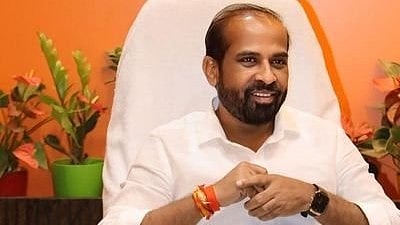
Andhra Pradesh minister A Satya Kumar.
Credit: X/@satyakumar_y
Hyderabad: The Andhra Pradesh government has reignited a longstanding national debate on the scope of practice for Ayurvedic doctors by announcing its plan to allow qualified practitioners to perform surgical procedures independently.
State Health Minister Satya Kumar Yadav, a BJP legislator in N Chandrababu Naidu’s TDP-led NDA cabinet, recently approved this move, calling it a step towards integrating traditional Indian systems of medicine with modern healthcare.
The decision applies to Ayurvedic doctors who have completed postgraduate education in surgical disciplines and undergone appropriate clinical training.
Yadav emphasised that the decision aligned with the provisions of the Indian Medicine Central Council (Post Graduate Ayurveda Education) Amendment Regulations, 2020, and guidelines issued by the National Commission for Indian System of Medicine (NCISM).
The state’s Ayurveda, Yoga and Naturopathy, Unani, Siddha and Homoeopathy (AYUSH) Department has been directed to operationalise the measure in consultation with academic and regulatory bodies.
Under the new framework, qualified Ayurvedic practitioners will be permitted to perform 39 Shalyatantra (general surgery) and 19 Shalakyantra (ENT and ophthalmology) procedures.
These cover the treatment of wounds and infectious diseases; removal of damaged tissues following accidents and suturing; treatment of piles and fissures; excision of cysts and benign tumours; muscle and skin grafting therapies; and certain head, throat, and dental operations.
Objections
The Indian Medical Association (IMA), however, has come out strongly against the state’s decision, emphasising potential risks to patient safety.
“While the IMA respects all systems of medicine and acknowledges Ayurveda’s role in preventive care, performing surgical procedures requires structured and specialised training integral to modern medical education,” said IMA National President Dr Dileep Bhanushali.
He argued that surgery demands a comprehensive understanding of anatomy, physiology, pathology, anaesthesia, emergency management, and postoperative critical care — subjects studied in depth during MBBS and MS courses.
Meanwhile, Ayurvedic practitioners across Andhra Pradesh and the country have welcomed the move, calling it a long-overdue recognition of structured surgical training in Ayurveda.
Dr Mamidi Gurumurthy, an Ayurveda practitioner in Vijayawada who has been performing minor surgical procedures, said critics are unfairly dismissing a time-tested science. “It is unfortunate that Ayurveda, which was founded by Sage Sushruta, the father of surgery, is being labelled as quackery,” he told DH.
“We, too, study anatomy, physiology, pathology, and other branches similar to MBBS students. The BAMS degree is awarded to Bachelors of Ayurvedic Medicine and Surgery. We are already trained to perform minor operations, and those are precisely the ones being regularised now,” he said.
Gurumurthy added that with proper training through integrated courses, such as those offered by institutions like Jawaharlal Institute of Postgraduate Medical Education and Research (JIPMER) in Puducherry, Ayurvedic surgeons can safely expand their skill sets to perform even major surgeries.
“In Maharashtra, many Ayurveda doctors perform laparoscopic procedures better than regular allopathy doctors,” he claimed. “Ultimately, it depends on training and individual competence. Haven’t we seen MBBS doctors who can’t administer an injection properly?”
Medical considerations
Gurumurthy, however, acknowledged that many Ayurvedic practitioners rely on allopathy-trained anaesthetists and modern post-operative care, including antibiotics and pain management, due to the limited availability of anaesthesia specialists in AYUSH hospitals.
The Vishwa Ayurveda Parishad (VAP), which represents Ayurvedic doctors nationally, hailed the Andhra Pradesh government’s decision as a landmark reform.
“This progressive step recognises the depth and rigour of Ayurvedic surgical education and strengthens India’s integrated healthcare system,” said Dr Sahithi Seelam, the general secretary of VAP’s Andhra Pradesh unit.
“Ayurvedic surgeons undergo extensive academic and clinical training, including exposure to modern techniques. Granting them the rightful scope of practice ensures people have access to safe and ethical healthcare,” she told DH.
Seelam criticised the IMA’s opposition as misplaced. “Instead of creating divisions within the healthcare fraternity, all systems of medicine should work in harmony for the larger benefit of society,” she said, assuring that Ayurvedic practitioners remain committed to professional ethics, patient safety, and interdisciplinary collaboration.
Some health professionals, while acknowledging the legal provisions, cautioned that effective oversight was critical. “Only those practitioners who are formally trained in recognised universities with appropriate specialist qualifications can safely perform surgeries,” said Dr Ambati Naga Radhakrishna, a dental surgeon and faculty member in an Andhra Pradesh medical college.
“Patient safety demands robust regulatory enforcement, which is currently inadequate in identifying and stopping unqualified practitioners,” he told DH.
He also warned that if individuals without proper training undertook delicate procedures such as eye surgeries or skin grafting, “the risk of blindness, disability, and disfigurement becomes unacceptably high”.
Radhakrishna also pointed to widespread lapses in faculty standards and infrastructure across medical and dental colleges, saying that weak enforcement continues to endanger patient safety.
As Andhra Pradesh moves to formalise these permissions, health officials said modalities are still being worked out before issuing final orders.