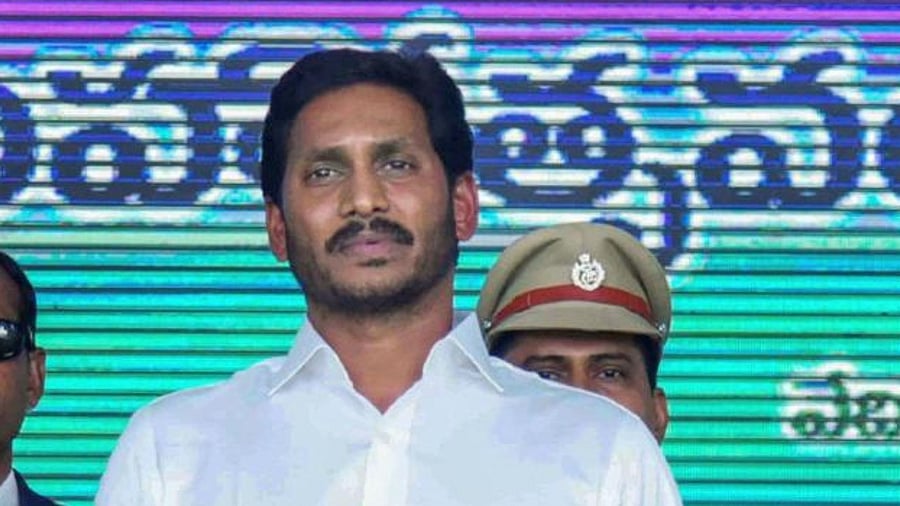
Former-Andhra Pradesh CM YS Jagan Mohan Reddy.
Credit: PTI File Photo
Hyderabad: A fierce political row has erupted in Andhra Pradesh over the state government’s decision to develop medical colleges and hospitals under the Public-Private Partnership (PPP) model.
While the ruling TDP led NDA government insists the initiative will strengthen public healthcare without financial strain on the exchequer the opposition YSR Congress Party (YSRCP), however, calls it privatisation in disguise and has mounted a statewide agitation against the proposal.
Over the past week, the YSRCP has conducted a state-wide campaign collecting one crore signatures against the PPP move. On Thursday, party president and former chief minister YS Jagan Mohan Reddy submitted the signatures to Governor S Abdul Nazeer, urging him to direct the government to withdraw the proposal. Reddy alleged that the model would commercialise healthcare and burden the poor, while the TDP asserts that ownership and free public health services will remain firmly under government control.
The state had sanctioned 17 new medical colleges between 2020 and 2021 at an estimated cost of Rs 8,480 crore. Of these, six have started operations by the 2023–24 and 2024–25 academic years. The remaining ten at Adoni, Madanapalle, Markapuram, Pulivendula, Penugonda, Palakollu, Amalapuram, Narsipatnam, Bapatla, and Parvathipuram remain incomplete. The previous government spent Rs 1,550 crore on them in four years.
A senior official from the Chief Minister’s Office explained that delays made it clear the projects would not finish within a reasonable timeframe, prompting the decision to move forward under the PPP mode. The model, the official said, aims to leverage private efficiency, ensure faster completion, and save around Rs 3,700 crore in initial costs and Rs 500 crore annually in operations and maintenance.
Initially, four medical colleges Pulivendula, Madanapalle, Markapur, and Adoni will be offered on a Design-Build-Finance-Operate-Transfer (DBFOT) basis. Each will include an upgraded district hospital expanded from 420 to 625 beds, along with a college offering 150 undergraduate and 24 postgraduate seats. Project costs are projected between Rs 410 crore and Rs 446 crore per college, with land parcels ranging from 50 to 95 acres.
Under the agreement, selected private partners will upgrade and operate existing facilities per National Medical Commission (NMC) norms and make the colleges functional within a year. They will also handle operation and maintenance for two years, or until new 625-bed hospitals are ready. The land remains government-owned and leased at Rs 100 per acre per year, reverting to the state after the 33+33-year concession period.
According to government sources, outpatient services and generic drugs will remain free for all patients. For inpatient services, 70% of beds will continue to be provided free under Ayushman Bharat-PMJAY, NTR Vaidya Seva Trust, and CGHS schemes, while the remaining 30% will be chargeable at market rates. Tariffs will be regulated by the Andhra Pradesh Medical Education and Research Corporation (APMERC).
The private concessionaire will handle financing, construction, staffing, and accreditation to maintain NABH standards. After the end of the concession period, all assets will revert to the government.
“Public-Private Partnership (PPP) and privatization are two different approaches to involving private entities in public services. In PPP, the government retains ownership of assets like medical colleges and hospitals, while private companies invest, build, and operate them for a fixed period. The government continues to control key areas such as academics and healthcare standards. In contrast, privatization involves the full transfer of ownership and control to the private sector, with no government oversight. PPP aims to improve service delivery using private expertise, reduce financial burden on the government, and avoid ongoing operational costs, with risks shared between both parties. In this case its PPP model not privatisation,” said a senior leader of TDP.
Officials pointed out that the Centre is actively promoting PPPs in both education and healthcare sectors, providing up to 80% of capital grant support under Sub-Scheme II. States such as Uttar Pradesh, Odisha, Jharkhand, and Arunachal Pradesh are adopting similar frameworks to modernise public healthcare.