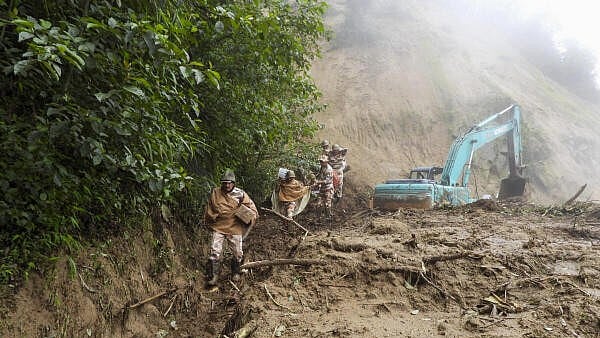
Heavy rains triggered landslides in Arunachal Pradesh. Image for representative purpose.
Credit: PTI Photo
Itanagar: Arunachal Pradesh faced a challenging year in 2025, which saw a diplomatic row over the harassment of an Arunachalee woman at Shanghai airport, protests against a power project and natural disasters affecting over 16,000 people.
The year also witnessed the NDA’s dominance in the political sphere with the BJP winning a majority of zilla parishad and gram panchayat constituencies and emerging victorious in civic elections.
The BJP bagged 170 out of 245 zilla parishad member (ZPM) seats, including 59 uncontested ones, establishing its clear dominance at the district level. The party won 14 of the 20 wards in the Itanagar Municipal Corporation elections, while it got two wards, and its partner Peoples' Party of Arunachal (PPA) secured five in the Pasighat Municipal Council. The opposition Congress failed to open its account in both civic bodies.
The year’s most-talked-about episode was the ordeal of Pema Wangjom Thongdok, an Arunachal Pradesh native residing in the UK, who was allegedly detained for nearly 18 hours at Shanghai airport in November while transiting from London to Japan.
According to her, Chinese immigration refused to recognise her Indian passport, declaring it “invalid” because the document listed Arunachal Pradesh as her birthplace. She also claimed that officials at the airport allegedly insisted Arunachal was “part of China” and pressured her to accept their claim.
“I was held at Shanghai airport for over 18 hours…They called my Indian passport invalid because my birthplace is Arunachal Pradesh, which they claimed is Chinese territory,” she had written on X, describing deprivation of food and facilities.
The Centre had immediately issued a strong demarche to the Chinese side, with the Indian consulate in Shanghai intervening in the matter.
Chief Minister Pema Khandu condemned the incident as “unacceptable, unlawful and an affront to India’s sovereignty”.
On the domestic front, the proposed 11,000-MW Siang Upper Multipurpose Project, considered India’s counter initiative to a big Chinese dam, faced fierce resistance from the indigenous Adi community people, who had held protests claiming that the initiative could lead to displacement and irreversible ecological damage.
Villagers and organisations like the Siang Indigenous Farmers Forum (SIFF) alleged that the project was being pushed without their consent. Communities feared submergence of 27 villages and displacement of 1.5 lakh people, along with loss of agricultural land, deforestation, and threats to fragile ecosystems.
Even culturally significant sites like Kekar Moying, linked to the Anglo-Abor war, were perceived as at risk.
Acknowledging anxieties, Khandu said hydropower generation is only a by-product, asserting, “The real objective of the project is to save the Siang river and the communities that have depended on it for generations.” He also assured, “If you don’t want a dam…Chapter closed.” Experts, however, dubbed the Siang project a strategic one as it could potentially mitigate risks of the Chinese dam being constructed in the upper stream of the Brahmaputra river. A major corruption controversy also came to the fore during the year over compensation for the Lada-Sarli stretch of the Frontier Highway project in East Kameng district.
Local organisations alleged that payments were made for non-existent land and assets, while genuine landowners were deprived.
Following a preliminary probe, the state government suspended four officials - the DFO, district agriculture officer, district horticulture officer and district land revenue and settlement officer - and recommended suspension of the deputy commissioner. Later, one of the four officers was arrested.
Claiming that preliminary findings revealed “massive misuse” of funds, Khandu asserted that his government would not tolerate this, and the misused money would also be recovered.
The arrest of four people by Arunachal Pradesh Police for allegedly sharing sensitive security-related information with Pakistani handlers also drew media attention.
The arrests were made in Itanagar Capital Region, Aalo in West Siang district and Miao in Changlang, following coordinated intelligence inputs. Cases were registered under multiple provisions of the Bharatiya Nyaya Sanhita and the Official Secrets Act, highlighting heightened counter-espionage action in the sensitive border state.
One of the deadliest road accidents of the year was reported from the remote Anjaw district, where a mini-truck with 22 labourers on board from Assam’s Tinsukia district plunged into a gorge on the Hayuliang–Chaglagam road on December 8, killing at least 18 people and leaving several others missing.
A multi-agency operation involving the Army, NDRF, police and civil administration was launched to locate and retrieve the bodies, underscoring the challenges of disaster response in Arunachal Pradesh’s far-flung border areas.
Monsoon rains caused destruction across 26 districts, killing 16 people, affecting nearly 40,000, and damaging over 670 houses.
From international confrontation to local unrest and disaster response, 2025 etched a defining chapter for Arunachal Pradesh, a year that tested its institutions, emboldened its communities and reaffirmed its strategic importance.