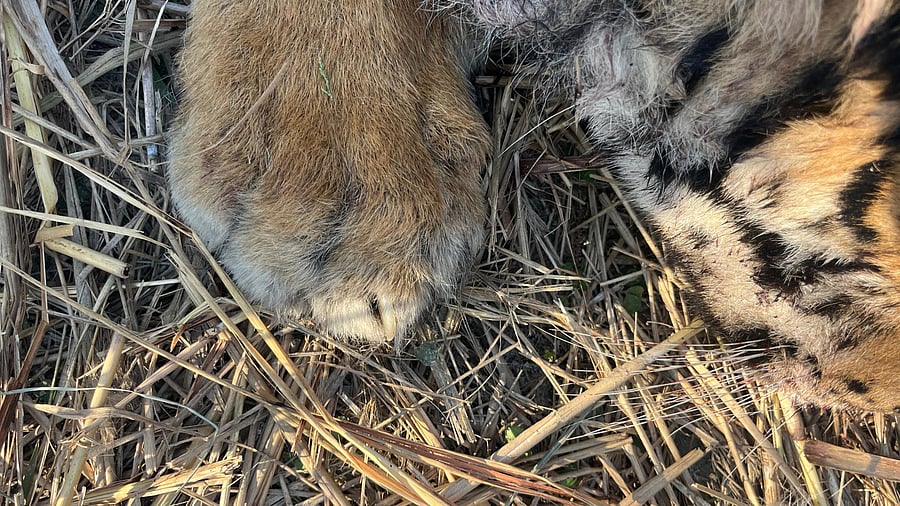
Carcass of a tiger.
Credit: Kaziranga National Park and Tiger Reserve, Assam.
Guwahati: Kaziranga National Park and Tiger Reserve (KNPTR) in Assam have witnessed death of three Royal Bengal tigers in a fortnight with officials suggesting infighting as the cause of the deaths.
With 148 tigers, 1,307sqkm Kaziranga has third highest density of tigers after Bandipur in Karnataka and Corbett National Park in Uttarakhand.
Third death was reported on Sunday when forest officials found the carcas of a female tiger at Kathpora area under the park's Westen Range Bagori. "A committee was constituted by Director, KNPTR for carrying out post mortem examination and disposal of carcass as per the Standard Operating Procedure of the National Tiger Conservation Authority. Preliminary findings during post mortem suggest that infighting has led to death of tiger," divisional forest officer, Arun Vignesh said in a short statement.
The park shared video and photos of the deceased tiger.
Two such deaths took place on January 4 and 14. One carcass of female tiger was recovered on January 4 at Paschim Bimoli area of Western Range Bagori. On January 14, a male tiger was found dead by the staff of Gopaljarani anti-poaching camp under Eastern Range Gamiri during regular patrolling.
Push factor -
When asked about any specific push factor towards the three fatal infighting since January 4, director of the park, Sonali Ghosh told DH, "No reason, its part of natural process of selection."
Firoz Ahmed, an expert on tiger conservation, however, said although infighting is natural, infighting in Kaziranga may be influenced by tiger's ability not to move out of Kaziranga and settle elsewhere outside the core area and upper limit of Kaziranga's tiger population.
"Infighting is natural and mostly happen when territories overlap or resource is scarce. As far as resource is concerned, that is not the cause for Kaziranga due to high diversity and population of prey animals of tigers.
The cause may be because the tigers don't find space out of the core areas. For example, the Karbi hills, although close to the park, it can only accommodate very few tigers due to low number of prey animals in the landscape. Working with communities and improving habitats can be a solution.
Similarly, Laokhowa and Buhrachapori, if habitat is improved, some tigers may be able to move out of Kaziranga and settled there. It is important that population is managed scientifically for both tigers and prey animals inside core areas for a long term conservation of species and improve co-existence with people," said Ahmed, who heads the tiger research and conservation division of Aaranyak, a biodiversity conservation group in Guwahati.
Infographics -
January 4: Carcass of a female tiger found at Bagori range.
January 14: male tiger found dead at eastern range Gamiri.
January 18: female tiger carcass detected at eastern range Bagori.
Number of tiger at Kaziranga: 148 (2024), 104 (2022)
Tiger density -
Bandipur: 19.83 tigers/100sqkm
Corbett: 19.56 tigers/100sqkm
Kaziranga: 18.65 tigers/100sqkm.