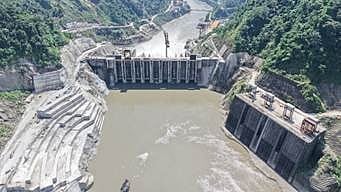
The Subansiri Lower Hydroelectric Project.
Credit: Ministry of Power
Guwahati: India's largest hydropower power project, the 2,000 MW Subansiri Lower Hydroelectric Project, finally began operating with one of its eight units (unit 2) starting on Tuesday. This comes after 20 years of work that saw public protests and cost escalation.
The 250 MW unit of the project on Subansiri river at Gerukamukh situated along Assam-Arunachal Pradesh border was virtually inaugurated from New Delhi by Union Minister of Power, Manohar Lal Khattar, in the presence of Pankaj Agarwal, Secretary (Power), Bhupender Gupta, CMD, National Hydroelectric Power Corporation (NHPC), and others.
Lal said the Subansiri project stands as a symbol of India’s commitment to clean and sustainable energy, supporting North-East India’s growth, strengthening the national grid and advancing India’s ambitious Net Zero goals. "Commissioning of the unit is not just a technical achievement, but a testament to years of hard work, dedication, and teamwork.”
The remaining seven units (250 MW each) are scheduled for commissioning in phases during 2026-27. "Upon full commissioning, the 2,000 MW Subansiri Lower Hydroelectric Project will make a significant contribution to India’s renewable energy capacity, enhance national grid resilience and usher in a new era in massive clean energy contribution," the Ministry of Power said in a statement.
It further said the Subansiri project exemplifies engineering excellence, featuring India’s heaviest hydro generator rotors, largest stators and biggest main inlet valves, along with innovations such as the nation’s largest aggregate processing plants, highest-capacity batching plant and first-ever use of Rotec’s Tower Belt for dam concreting in India.
"As the first cascaded dam on the Subansiri River, it provides flood moderation with a 442 million cubic metre flood cushion. With a gross reservoir storage of 1,365 million cubic metres at FRL, about one-third remains empty during floods to absorb excess water and protect downstream communities."
Protests and cost escalation
The work on the project began way back in 2005, two years after it was approved by the Centre. The initial estimated cost of the project was pegged at Rs 6,285 crore and 2012 was set as the year of completion.
However, the project work remained stalled between 2011 and 2019, due to agitation by anti-dam organisations in downstream areas of Assam.
ome had even moved the National Green Tribunal alleging that the project neglected safety concerns in the northeast, region a seismically active zone, and the possible adverse impact on the ecology and people living in the downstream areas.
The work, however, resumed in 2019 but the cost shot up to Rs 27,000 crore.