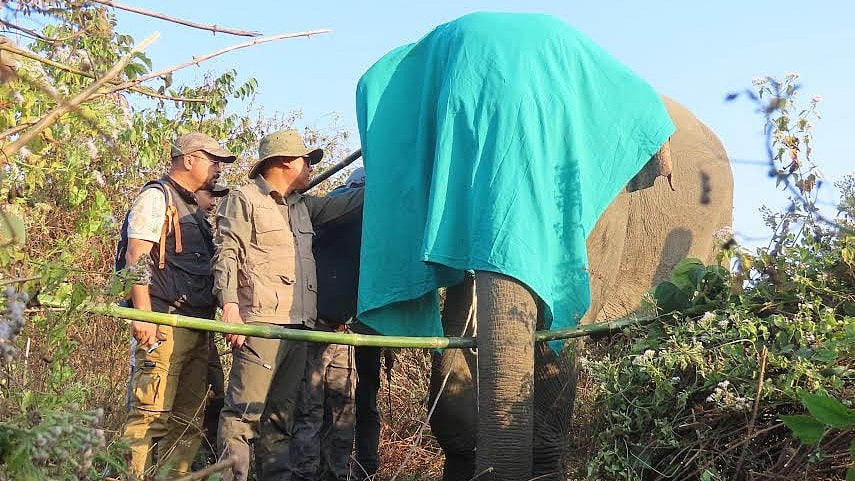
Conservationists in Assam are taking help of satellites for monitoring herds of wild elephants.
Photo credit: Aaranyak, Guwahati
Guwahati: Conservationists in Assam are taking help of satellites for monitoring herds of wild elephants that frequent the hills of neighbouring Bhutan and faces rising conflict with humans, resulting in deaths and destructions.
At least four wild elephants have been radio collared jointly by conservation groups and the state forest department in Baksa and Udalguri district, situated along Indo-Bhutan landscape, already identified as one of the hotspots of human-elephant conflicts in Assam. This took the number of radio collaring of wild elephants in Assam to nine so far.
"We are tracking movement of the herds three times in a day and are sharing the data with the forest department and other related stakeholders to reduce conflicts," Bibhuti Prasad Lahkar, an elephant conservationist with Aaranyak, a bio-diversity conservation group in Assam, told DH.
"The GPS tracker has been fitted in one of the elephants as elephants move in herds and so that we can track movement of the herd. The herds we are monitor has been found frequenting inside Bhutan and in Indian side. We are trying to monitor their movement, their routes and habitats so that proper conservation plans can be put into place in order to reduce conflict and restore elephant habitats," he said.
Two wild elephants were radio collared in Baksa forest division in November last year and on January 7 with Aaranyak with a major technical partner. Two more will be radio collared in neighbouring Chirang district soon, Lahkar said. Another two wild elephants were similarly tagged with satellites last year in Udalguri, another worst hit district, with WWF India as the major technical partner. Lahkar said another five jumbos were similarly radio collared earlier in Golaghat and Sonitpur district, another two worst-hit districts.
Udalguri and Baksa has turned out to be among major hotspots of human-elephant conflict in Assam with the two districts regisering over 120 human deaths and 52 elephant deaths since 2019. At least 90 people died due to such conflicts in Udalguri alone while 33 jumbos were killed. At least 70 people and 80 wild elephants die annually across Assam due to human-elephant conflicts.
"Habitat fragmentation is one of the major reasons resulting rising problem of human elephant conflict. If we can identify the habitats by using the sattellite technology and restore them, the conflict can be reduced. The radio collaring of the elephants helped states like Karnataka and Maharastra in this regard," Lahkar said.
Divisional Forest Officer of Baksa forest division, Golap Baniya said GPS-based satellite-radio telemetry collar which was fitted to the elephants will help to assess the migratory pattern, vegetative preferences of the wild elephant’s and the herd it belongs to. "The locations provided by the collar will also act as an early alert system to help in better management of human-elephant conflict in the landscape.”
Assam is home to 60 per cent of India's wild elephants and the latest census conducted by the state forest department found 5,828 elephants. It found the protected areas like Kaziranga-Karbi Anglong and Chirang-Ripu Elephant Reserves as the jumbo's lifelines, hosting over 68 per cent of the population. Assam, home to nearly 60 per cent of India’s elephants, is a pivotal stronghold for this endangered species.