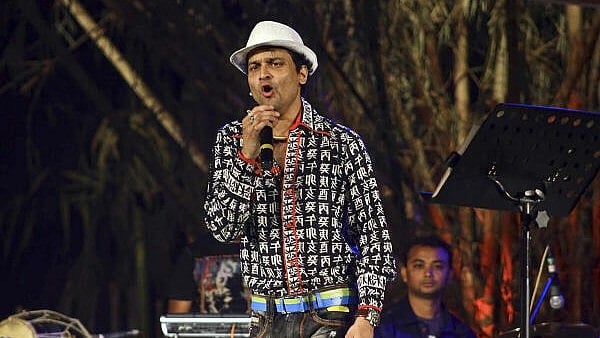
Zubeen Garg
Credit: PTI Photo
Guwahati: The mysterious death of Assam’s cultural icon Zubeen Garg cast a long shadow over the state in 2025, eclipsing major political and administrative developments and triggering an unprecedented public outcry that reverberated through the corridors of power.
The year was also marked by political sparring ahead of the 2026 assembly elections, which included allegations involving national security, campaigns against infiltration, and the passage of a bill banning polygamy. The birth centenary celebration of another iconic son of Assam, Bhupen Hazarika, was also launched this year.
Garg, who had travelled to Singapore to attend the North East India Festival, died while swimming in the sea on September 19. The unexpected news stunned Assam, while the circumstances of the singer’s death sparked widespread suspicion.
Lakhs of people lined the streets as Garg’s mortal remains were flown back from Singapore. For three days, his body was kept in a stadium for the people to pay their homage before being cremated amid scenes of grief and anger.
Public sentiment soon turned into mass protests demanding justice and the arrest of festival director Shyamkanu Mahanta, Garg’s manager Siddhartha Sharma and others who had accompanied him to Singapore and were present on the yacht during his final hours.
Under mounting pressure, the Assam government constituted a Special Investigation Team of the CID. On December 12, the SIT filed a charge sheet accusing Mahanta, Sharma and Garg’s band members Shekharjyoti Goswami and Amritprava Mahanta of murder.
The singer’s cousin Sandipan Garg, an Assam Police official who had also accompanied him, was charged with culpable homicide not amounting to murder, while his two personal security officers — Nandeswar Bora and Paresh Baishya — were booked for criminal conspiracy and criminal breach of trust.
The case quickly assumed political overtones, with both the ruling and opposition parties seeking to capitalise on the developments. A massive social media campaign - #JusticeForZubeenGarg - emerged, recording one of the highest-ever engagements seen in the state under this hashtag.
The trial has begun in a court, with the state government promising to seek fast-tracking of the case in the Gauhati High Court and the appointment of a special prosecutor.
Amid the turmoil, Garg’s last film, ‘Roi Roi Binale’, was released on October 31, as per his plans, and went on to become the highest-grossing Assamese movie till date.
The cultural sphere also witnessed the launch of the year-long centenary celebrations of Bhupen Hazarika. Prime Minister Narendra Modi inaugurated the celebrations on September 13, with multiple programmes planned across the country. President Droupadi Murmu is scheduled to attend the concluding ceremony next year.
On the political front, Chief Minister Himanta Biswa Sarma triggered a controversy by alleging that Deputy Leader of the Opposition in the Lok Sabha, Gaurav Gogoi, and his British wife Elizabeth Colburn had links with Pakistan’s intelligence agency ISI.
An SIT was set up to probe the alleged links of the couple with Pakistani national Ali Tauqeer Sheikh. The report was submitted to the chief minister on September 10.
Sarma claimed that the probe had “unearthed startling facts which point towards a larger conspiracy aimed at undermining the sovereignty of our nation,” adding that the case would soon be handed over to a central agency.
Gogoi, who was appointed Assam Congress president after the allegations surfaced, dismissed the charges as a “C-grade Bollywood film” that would flop, asserting that the people of Assam “understand everything”.
Opposition parties alleged the accusations were politically motivated and aimed at influencing next year’s assembly polls. Gogoi said the opposition was ahead of the BJP in poll preparations and alliance-building.
Eight opposition parties, including the Congress, subsequently announced plans to contest the assembly elections together.
The chief minister, however, asserted that the Congress had already “conceded” defeat in the 2026 and 2031 assembly elections and was preparing for 2036, with an NDA victory in the state being a “foregone conclusion”.
Throughout the year, Sarma campaigned aggressively on the issue of infiltration, launching eviction drives in forest areas and ‘sattra’ (Vaishnavite monastery) property allegedly encroached upon by Bengali-speaking Muslims. He claimed the government was committed to an infiltration-free Assam, asserting that 35–40 people were being “pushed back” every week.
The administration also rolled out several welfare schemes for women, girls and students, while the chief minister said nearly 1.5 lakh people had been provided government jobs over the last five years.
Political observers viewed the tabling of the Tewary and Mehta Commission reports — related to violence ahead of the 1983 assembly elections, including the Nellie massacre — with scepticism, terming it poll-driven.
Similarly, the introduction of bills on polygamy, land rights for tea garden workers and the cabinet sub-committee report on granting Scheduled Tribe status to six communities were seen as attempts to consolidate electoral support.
Electorally, the BJP-led alliance swept the panchayat polls but suffered a setback in the Bodoland Territorial Council elections, losing power to the Bodoland People’s Front, which also became a part of the NDA.