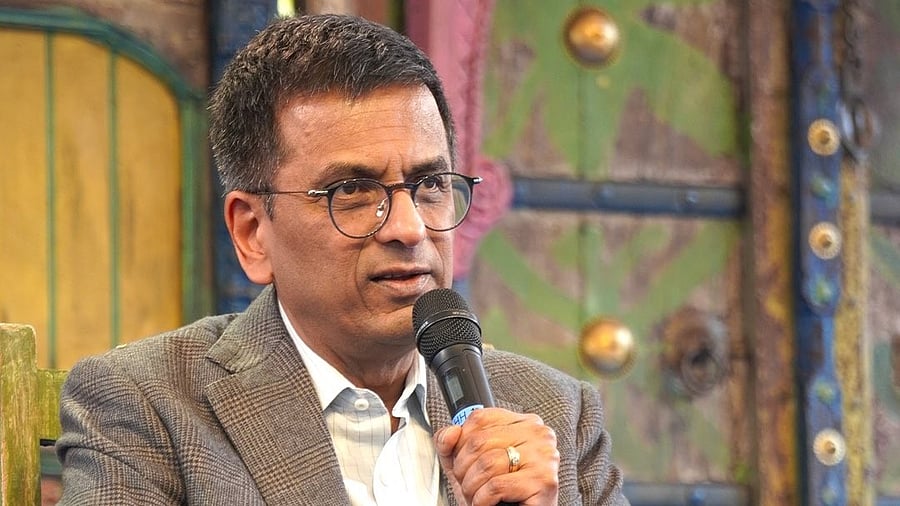
Former Chief Justice of India D Y Chandrachud.
Credit: X/ @JaipurLitFest
Jaipur: Former chief justice of India D Y Chandrachud on Sunday said bail before conviction should be a matter of right, but asserted that it is a court's duty to examine a case in depth where national security is involved before granting such a relief.
He made the remarks at the ongoing Jaipur Literature Festival in response to a question from senior journalist Vir Sanghvi, who raised the issue of the Supreme Court recently denying the bail plea of activist Umar Khalid in the 2020 Delhi riots conspiracy case.
Khalid and fellow activist Sharjeel Imam have been incarcerated since 2020. Denying bail to both, the top court on January 5 observed that they were involved in the "planning, mobilisation and strategic direction" of the northeast Delhi riots.
Faced with the question from Sanghvi during a session titled 'Ideas of Justice', Justice Chandrachud (retired) said, "Bail before conviction should be a matter of right. Our law is based on a presumption, and that presumption is that everyone is innocent until proven guilty."
"Because, if someone remains an undertrial prisoner for five or seven years and is finally proven innocent, how will you compensate for the time lost?"
Giving examples from various cases, the former chief justice of India said that bail can be denied if there is a possibility of the accused returning to society and committing the crime again, tampering with evidence, or using the benefit of bail to escape the clutches of the law.
"If these three grounds are not present, then bail must be granted. I think that where national security is involved, it is the court's duty to examine the case in depth. Otherwise, what is happening is that people remain imprisoned for years," he said.
Justice Chandrachud termed the denial of bail by sessions and district courts a matter of concern and said judges fear that their integrity might be questioned. "This is the reason why bail cases reach the Supreme Court," he said.
Expressing concern over the delay in disposal of cases by the Indian criminal justice system, he said the Constitution is the supreme law, and there is no concrete exception in the matter. "If there is a delay in a speedy trial, the accused is entitled to bail."
Listing landmark Supreme Court decisions during his tenure, Justice Chandrachud mentioned the grant of permanent commission to women in the armed forces, decriminalisation of homosexuality, and striking down the electoral bonds scheme.
In response to a question, the former CJI suggested including eminent persons from civil society in the collegium for the appointment of judges in high courts and the Supreme Court to ensure transparency and strengthen people's faith in the judiciary.
On the question of not accepting any post after retirement, Justice Chandrachud said that at present, he is enjoying the life of a private citizen.
Asked about any regrets he had, the former CJI said that marital rape has not been criminalised even over seven decades since Independence and strongly advocated for changes in the law for this.
He also expressed happiness over his efforts to make the Supreme Court a "people's court". During his tenure, the live telecast of Supreme Court proceedings was started not only in Hindi but also in all Indian languages listed in the Eighth Schedule of the Constitution.