
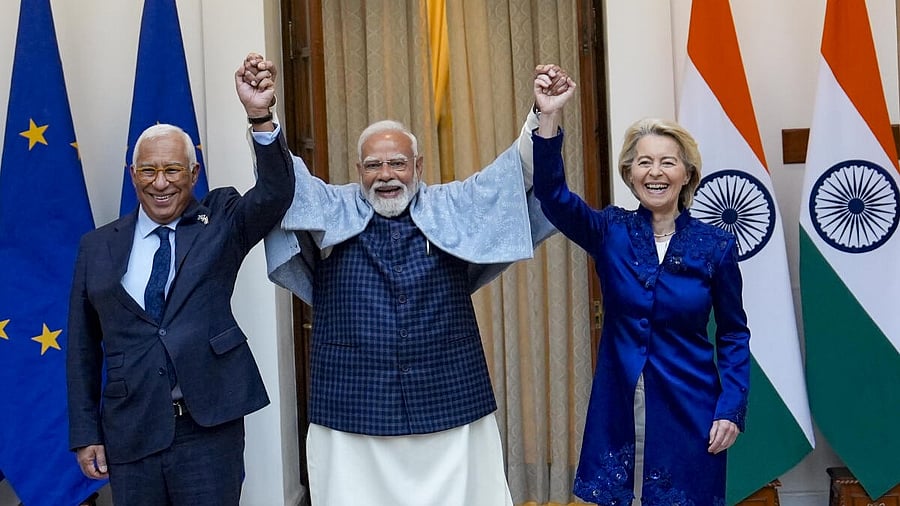
Prime Minister Narendra Modi with European Council President Antonio Costa, left, and European Commission President Ursula von der Leyen, right, during their meeting at the Hyderabad House, in New Delhi, Tuesday, Jan. 27, 2026.
Credit: PTI Photo
New Delhi: Prime Minister Narendra Modi on Tuesday joined the European Council President António Luís Santos da Costa and European Commission President Ursula von der Leyen to call for respect for multilateralism and international norms, even as New Delhi announced a defence and security partnership with the 27-nation bloc and signed a Memorandum of Understanding on mobility.
The two sides launched negotiations for a Security of Information Agreement (SOIA), which will facilitate the exchange of classified information and pave the way for a stronger defence cooperation.
“Today, the global order is undergoing profound turbulence. In this context, the partnership between India and the European Union will strengthen stability within the international system,” Modi said after a meeting with da Costa and von der Leyen at Hyderabad House in New Delhi. “The respect for multilateralism and international norms remains a shared priority. We are united in our view that reform of global institutions is essential to address the challenges of our time.”
With the launch of the defence and security partnership and the conclusion of negotiations for the Free Trade Agreement (FTA), India and the EU on Tuesday signaled a strategic convergence even as both have been navigating growing commercial and geopolitical tension with the United States since Donald Trump’s return to the White House as the 47th American President.
The India-EU defence and security partnership will not only take the two sides to a new level of strategic trust but also pave the way for the two sides to work together to counter “the full range of security threats we face, in the Indo-Pacific, in Europe and around the world,” da Costa, the president of the European Council, said. “As the world's largest democracies and champions of multilateralism, the EU and India share the responsibility of upholding international law, with the United Nations Charter at its core.”
The FTA will bring together “India's skills, services and scale, with Europe's technology, capital and innovation”, von der Leyen, the president of the European Commission, said. “It will create levels of growth that neither side can achieve alone. And, by combining these strengths, we reduce strategic dependencies at a time when trade is increasingly weaponised,” she added, in a not-so-subtle message for Trump, who recently threatened to impose tariffs on the EU nations opposed to his bid to take control of Greenland, only to roll it back later.
Even as Modi and Trump had in February 2025 agreed to negotiate a trade agreement, the US president’s 50% tariff on India, including 25% specifically to dissuade it from buying oil from Russia, his bonhomie with the civil and military leaders of Pakistan in complete disregard of the sensitivities of India and his repeated claims of brokering the May 10, 2025, truce between India and Pakistan, strained the ties between New Delhi and Washington D.C., with no progress on the deal.
Modi said on Tuesday that the defence and security partnership would help India and the EU work more closely on counterterrorism, maritime security, and cybersecurity. “This will also strengthen our shared commitment to a rules-based international order. Our cooperation in the Indo-Pacific region will grow, and our defence companies will gain new opportunities to work together on co-development and co-production,” said the prime minister after co-chairing the 16th India-EU summit along with the leaders of the bloc. “Our partnership includes a dedicated dialogue on space security, from situational awareness to secure connectivity and stronger cooperation on counterterrorism,” added von der Leyen, adding that the two sides would deepen cooperation on maritime security, including through joint naval exercises to tackle piracy, and would step up cooperation in countering cyber and hybrid threats.
The strains in ties between New Delhi and Washington, D.C., cast a shadow of uncertainty over the Quad – a four-nation coalition India had forged with Australia, Japan and the US to counter China’s expansionist aspirations in the Indo-Pacific region. Modi, however, joined von der Leyen and da Costa on Tuesday to send out a subtle message to Beijing by underlining the need for a free, open, peaceful and prosperous Indo-Pacific, in accordance with international law, including the United Nations Convention on Laws of the Sea.
They welcomed closer India-EU engagement in the region, including the inaugural edition of the forthcoming India-EU consultations on Indo-Pacific in New Delhi.
With the Trump Administration restricting the issuance of visas for travel to the US for work and study, the India-EU mobility pact signalled Europe’s openness to Indian talent through smoother, rules-based movement of students and professionals. The new framework for mobility will open new opportunities for students, workers, and professionals from India in Europe, the prime minister said.
“We will facilitate the movement of students, researchers, seasonal and highly skilled workers. This is also why we are launching the first EU Legal Gateway Office in India. It will be a one-stop hub to support Indian talent moving to Europe, in full alignment with EU Member States' needs and policies,” said von der Leyen. “This is good for our economies. This is good for the friendship between our people. This openness benefits us all.”