
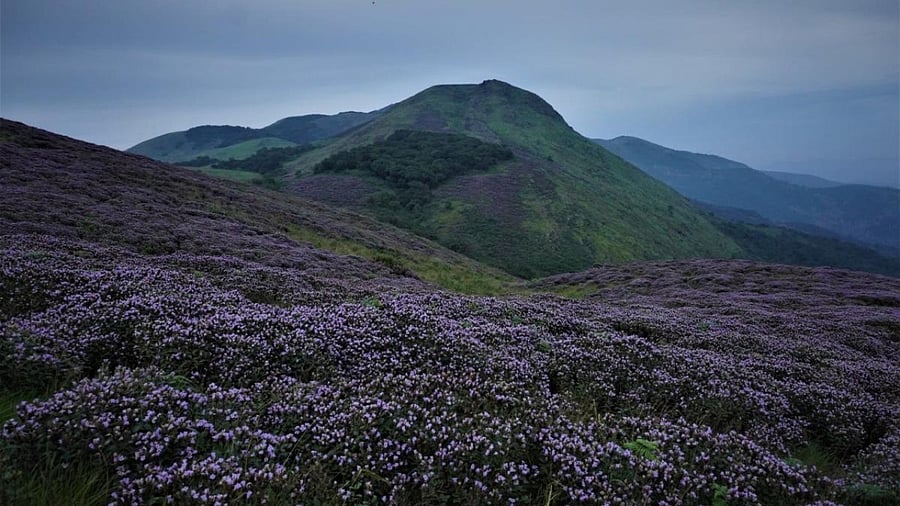
A view of the neelakurinji flowers.
Credit: Special arrangement
Bengaluru: The Botanical Survey of India (BSI), a premier government body engaged in taxonomic research, has proposed to study the threats faced by Neelakurinji, a flagship floral plant of the Shola grasslands of the Western Ghats, which blooms once in 12 years.
The institute has set up a three-member team for reassessment and re-validation on the threat status of the plant (Strobilanthes Kunthiana), whose rare flowering brings thousands of people to the Ghats.
The team will select samples from Bababudangiri-Kudremukh, Annamalai-Eravikulam, Nilgiri, Palani and among the smaller outliers of Shola-grassland ecosystems ranging from 1,300 to 2,400 metres of elevation in Karnataka, Kerala and Tamil Nadu.
Ministry of Environment, Forest and Climate Change and the BSI together filed a joint affidavit before the National Green Tribunal stating that despite its ecological and symbolic significance, the species was officially evaluated on a global scale only in 2024, with the International Union for Conservation of Nature (IUCN) listing it as a vulnerable species.
“Its unique 12-year mass-flowering cycle -- while a biological marvel -- poses significant challenges for population monitoring and environmental assessment, often delaying critical conservation interventions. The survival of Neelakurinji is currently jeopardised by the systematic fragmentation of the montane grasslands,” their joint statement said.
Threat assessment
The field observations will be integrated with land-use change data and supplements from the state forest departments of the three states to evaluate habitat degradation, invasive species, the impact of tourism and plantation encroachment.
The IUCN criteria will be applied to assess the level of threat faced by the plant. Population reduction, restricted geographic range with decline or fluctuation, small population size and decline, very small or restricted population and quantitative extinction risk analysis.
The study, estimated to take about six months, will also throw light on the altitudinal and climatic distributions. “This analysis will define the environmental parameters and habitat requirements critical to the taxon’s survival throughout its natural range.”
A senior official noted that the impact of linear projects, like roads and transmission lines, along with power generation and water diversion projects, is yet to be assessed.
“A cumulative assessment of the damage and habitat degradation caused by such projects during the construction and operation state is the need of the hour to conserve many species of flora and fauna,” he said.