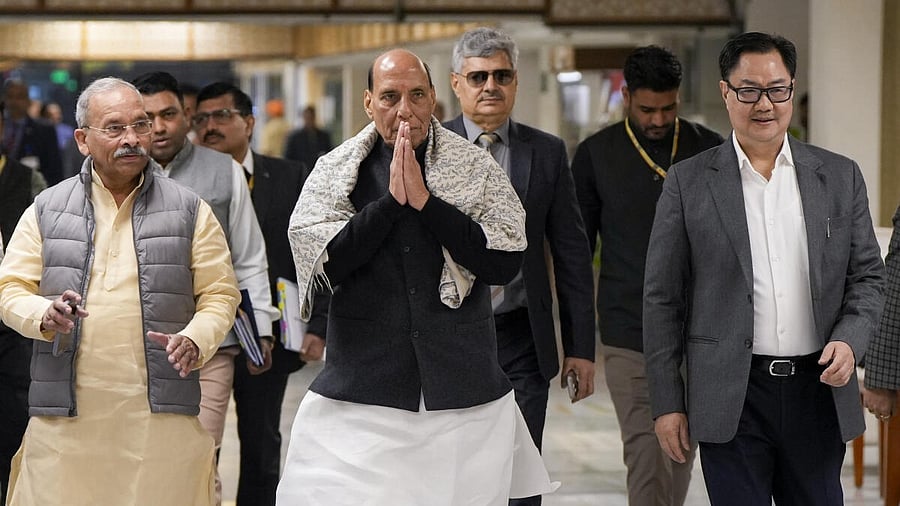
Defence Minister Rajnath Singh, centre, with Union Parliamentary Affairs Minister Kiren Rijiju, right, and others, arrives for the all-party meeting ahead of the Budget session of Parliament, in New Delhi, Tuesday, Jan. 27, 2026.
Credit: PTI Photo
New Delhi: The government and the Opposition are headed for a showdown on the VB-G RAM G Act and the SIR once again.
At the all party meeting held on Tuesday, chaired by Union Defence Minister Rajnath Singh, ahead of the Budget Session, the Opposition demanded a discussion on these issues, which was eventually turned down by the government. Opposition leaders also demanded a discussion on pollution, the statehood of Jammu and Kashmir and new UGC rules on caste discrimination.
Sharp differences emerged between the govt and the Opposition at the all-party meeting convened ahead of the Budget Session.
The meeting was called to seek cooperation from political parties for the smooth conduct of the Budget Session. However, it ended without consensus as opposition parties pressed for discussions on a range of issues, including the VB-G RAM G legislation and the SIR exercise.
Parliamentary Affairs Minister Kiren Rijiju said after the meeting that the government would not agree to reopening discussion on the VB-G RAM G law, which replaced the Mahatma Gandhi National Rural Employment Guarantee Act (MGNREGA). “Once a law is before the nation, we have to follow it. We cannot reverse the gear and go back,” Rijiju told reporters.
Rijiju said opposition members would be free to raise their concerns during the debate on the President’s address or the Union Budget but ruled out separate, issue-specific discussions. He also responded to complaints over the non-circulation of the government’s legislative agenda ahead of the session, saying, “Government business is shared after the President’s address,” and appealed to parties to allow Parliament to function smoothly.
Opposition parties, however, expressed dissatisfaction with the government’s stance, arguing that the VB-G RAM G law has significant implications for rural employment and livelihoods and therefore deserves further scrutiny. They also raised concerns over the Special Intensive Revision of electoral rolls, alleging that the process could lead to voter exclusion and needed to be debated on the floor of the House.
Congress’s K Suresh raised the issue of the government not circulating legislative agenda in time, a move which he said limited Parliament’s ability to prepare for an informed debate. The government, however, maintained that procedural norms were being followed and that repeated demands for separate discussions would disrupt the functioning of the Budget Session.
Congress MP Pramod Tiwari told reporters that they will raise issues of weakened Constitutional institutions, the falling rupee etc. “The rupee has surpassed the Prime Minister’s age. We will raise the issue of pollution. What is the situation in Indore? Statehood is not being restored in Jammu and Kashmir. The issue of vote manipulation is important. There is opposition within the government on the UGC issue,” Tiwari said.
Trinamool Congress leader Sagarika Ghose said the Opposition had sought space for discussion on multiple issues of public importance. “Parliament is not a one-way street. The opposition must be given an opportunity to speak, and its voice must be heard,” she said after the meeting.
CPI(M) Rajya Sabha member John Brittas said Opposition parties had placed a wide range of concerns before the government, including electoral issues and foreign policy. “We demanded discussions on SIR, on the changes to rural employment guarantees, and on foreign policy issues where India’s position is being weakened internationally,” Brittas said.