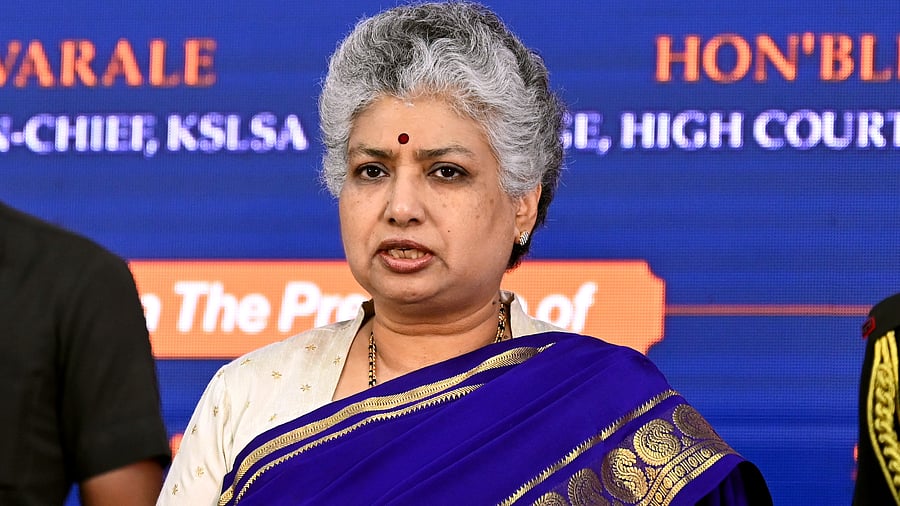
Credit: PTI File Photo
New Delhi: Taking note of the existence and persistence of cancerous corruption in the country, Supreme Court judge B V Nagarathna urged youngsters and children on Tuesday to shun the wealth acquired by their parents through corrupt means.
A bench of Justices Nagarathna and K V Viswanathan delivered a split verdict on the constitutional validity of a 2018 provision of the anti-graft law that mandates a prior sanction for initiating a probe against a government servant in a corruption case.
The observation came while holding that section 17A of the Prevention of Corruption Act is unconstitutional and needs to be struck down.
Section 17A of the Prevention of Corruption Act, 1988, introduced in July 2018, bars any "enquiry or inquiry or investigation" against a public servant for recommendations made while discharging official duties, without a prior approval from the competent authority.
The case will now be placed before Chief Justice of India (CJI) Surya Kant for forming a larger bench to hear the matter for a final decision.
Justice Nagarathna said because of the mad race for becoming rich and acquiring properties overnight, a cancerous growth of corruption has affected the moral standards of people and all forms of governmental administration.
"The youth and the children of this country ought to shun anything acquired beyond the known sources of income by their parents and guardians rather than being beneficiaries of the same. This would be of a seminal service rendered by them not only towards good governance but also to the nation," the judge said.
She said corruption is a result of greed and envy that give rise to an unhealthy competition to be acquisitive of material assets beyond known sources of income.
"A person may compete with another so as to portray materialistic superiority. This may result in acquiring wealth illegally. One's attitude of greed and envy ought to be curbed and erased from one's mind, otherwise corruption and bribery resulting in acquisition of wealth beyond the known sources of income cannot be reduced nor removed from our governance.
"One of the ways in which such tendencies could be curbed is to develop and enhance a spiritual bent of mind, resulting in detachment from materialistic possessions and thereby, inter alia, focussing on service to the nation," she said.