
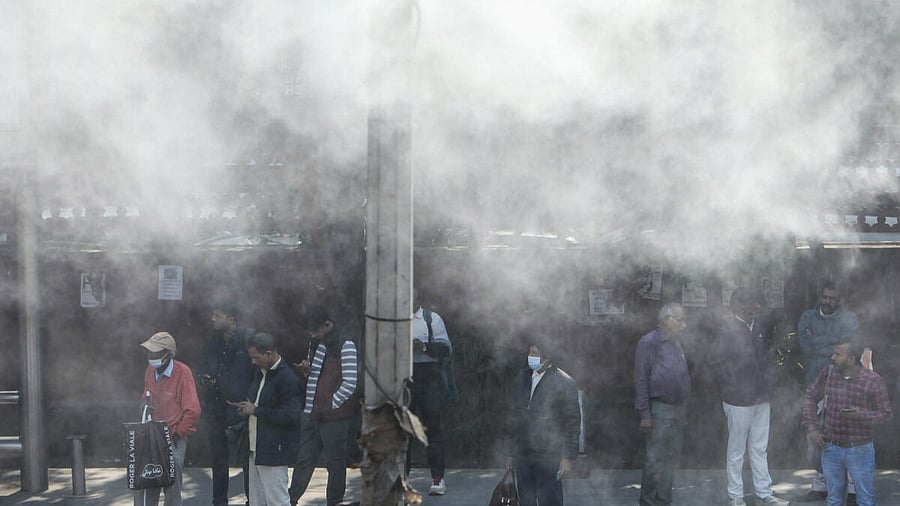
Commuters stand amidst water being sprayed to curb air pollution, in New Delhi.
Credit: PTI
New Delhi: Congress on Sunday asked the Modi government to acknowledge the public health crisis linked to air pollution and to increase the funding for the National Clear Air Programme (NCAP) from Rs 10,500 crore for 131 cities to Rs 25,000 crore spread across the 1,000 most polluted towns in the country.
It said the NCAP, which currently addresses “only 4% of India’s chronically polluted cities", has “actually become Notional Clear Air Programme” and needs a “thorough overhaul and reform”, which includes legal backing, an enforcement mechanism and serious data monitoring capacity for every city.
Claiming that air quality is a “nation-wide, structural crisis” for which the government response is “exceedingly ineffective and inadequate”, it also said that NCAP must adopt measurement of PM 2.5 levels as the yardstick besides reorienting its focus to key sources of emissions – burning of solid fuels, vehicular emissions and industrial emissions.
Congress General Secretary (Communications) Jairam Ramesh said the study by the Centre for Research on Energy and Clean Air (CREA) has found that nearly 44% of Indian cities — that is 1,787 out of 4,041 statutory towns assessed — have chronic air pollution, with annual PM2.5 levels consistently exceeding the national standard.
He said the report has highlighted the “ineffectiveness” of the NCAP as only 130 out of 1,787 are covered under it. Of the 130 cities, the report said, 28 still lack continuous ambient air quality monitoring stations (CAAQMS) while 100 cities out of 102 which have monitoring systems, reported PM10 levels of 80% higher.
Insisting that the first step is to acknowledge the public health crisis linked to air pollution across India, he said the government must revisit and totally revamp the Air Pollution (Control and Prevention) Act of 1981 and the National Ambient Air Quality Standards (NAAQS).
“As per the NAAQS, the permissible concentration of fine particulate matter is 60 µg/m3 for a 24-hour period, and 40 µg/m3 annually – versus the guidelines of less than 15 µg/m3 for a 24-hour period and 5 µg/m3 annually set by the WHO,” he said.
He also advocated that the government must “drastically increase” the funds made available under the NCAP from the current budget of Rs 10,500 crore, which is inclusive of NCAP funding and the 15th Finance Commission’s grants, for 131 cities.
“Our cities need at least 10-20 times more funding. The NCAP must be made a Rs 25,000 crore programme and spread across the 1,000 most polluted towns in the country,” he said.
Enforcing air pollution norms for coal power plants and installing Fluoride Gas Desulfurizer (FGD) by the end of 2026 were also suggested by Ramesh, who also wanted the restoration of the National Green Tribunal’s independence.
The former Environment Minister also demanded the roll back of “anti-people” amendments made to environmental laws during the Modi government.