
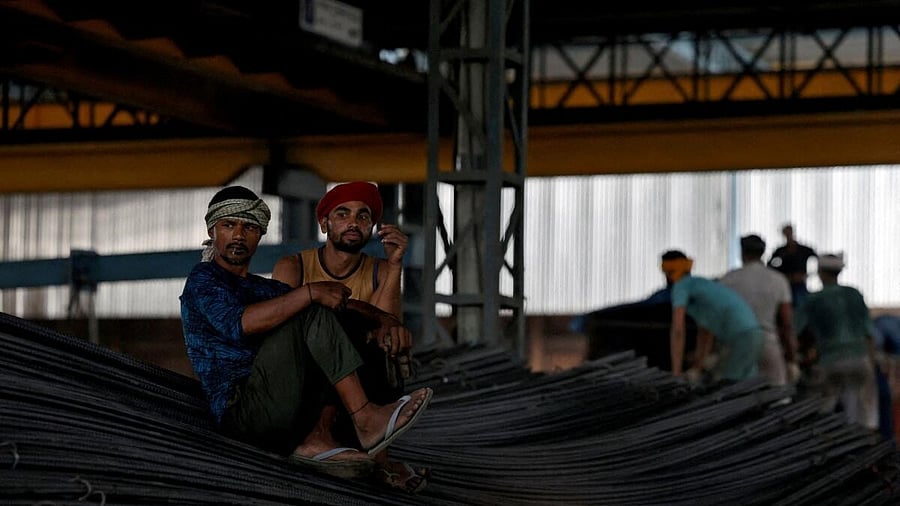
Steel production at a factory in Mandi Gobindgarh.
Credit: Reuters photo
New Delhi: Congress on Saturday said the implementation of new labour codes is being touted as "some revolutionary reform" but the question is will the government ensure a national minimum wage of Rs 400 a day, an employment guarantee law for urban poor and Rs 25 lakh universal health coverage.
A day after the Union government notified the four Labour Codes pending since 2020, the main opposition party raised the questions and said the Modi dispensation must learn from the examples of the Congress government in Karnataka and its former government in Rajasthan, which "pioneered labour reform with their groundbreaking gig worker laws that preceded the codes."
In a post on X, Congress General Secretary (Communications) Jairam Ramesh said, “29 existing labour-related laws have been re-packaged into 4 codes. This is being marketed as some revolutionary reform when even the Rules have yet to be notified.”
He asked, "but will these codes make these 5 essential demands of India’s workers for 'Shramik Nyay' (workers' justice) a reality? 1. National minimum wage at Rs 400 per day, including for MGNREGA 2. Right to Health law that will provide universal health coverage of Rs 25 lakh 3. Employment guarantee act for urban areas 4. Comprehensive social security for all unorganised workers, including life insurance and accident insurance 5. A commitment to stop contractualisation of employment in core Government functions."
The four Labour Codes -- the Code of Wages 2019, Industrial Relations Code 2020, Code on Social Security 2020 and Occupational Safety, Health and Working Conditions Code 2020 were notified on Friday to replace 29 laws. Rules for the codes will be issued shortly.
Opposition trade unions have already announced their disagreement, describing the implementation of four labour codes as a "genocidal attack" and "war on the working masses" while calling workers to "rise in rage" in joint action with farmers on November 26 to demand its scrapping.
Separately, the Delhi Union of Journalists (DUJ) condemned the implementation of four labour codes, urging media persons to join the protest on November 26 called by trade unions.
It said the Labour Codes are an attack on the freedom of press and freedom of expression, as it subsume the Working Journalists and other Newspaper Employees (Conditions of Service) and Miscellaneous Provisions Act (known as Working Journalists Act) and the Working Journalists (Fixation of rates of wages) Act passed by Parliament in 1955 and 1958.
"Both these Acts, passed after relentless struggles by journalists, functioned as pillars of freedom of press as they demarcated journalists and journalism from influence of media owners, advertisers and governments. Now, both these Acts will be a thing of the past at a time journalists are demanding expansion of the ambit of these laws to include journalists and workers from electronic and digital media," DUJ President Sujata Madhok, Vice President SK Pande and General Secretary AM Jigeesh said in a statement.