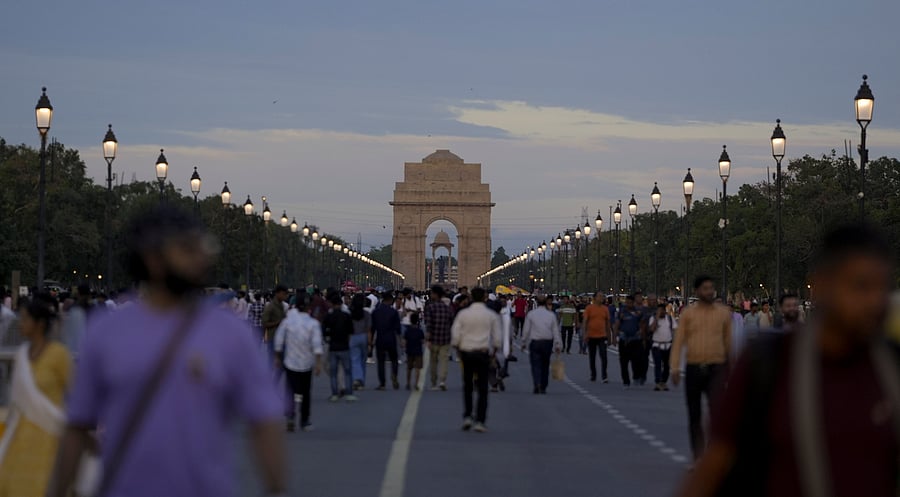
File photo for representational purpose.
Credit: PTI Photo
New Delhi: Delhi Environment Minister Manjinder Singh Sirsa on Thursday said the national capital recorded its best air quality in eight years in 2025.
The PM2.5 levels declined from 104 micrograms per cubic metre in 2024 to 96 in 2025, while PM10 levels fell from 212 micrograms per cubic metre to 197 during the same period, Sirsa said.
“Delhiites gave us the mandate to serve, and we made clean air our foremost pledge. The record good AQI days in 2025 prove that science-led action works wonders,” Sirsa said.
According to an official statement, Delhi recorded around 200 days in 2025 when the air quality index (AQI) remained below 200, an improvement of about 15 per cent compared to the previous four years.
Of these, 79 days fell in the 'good' and 'satisfactory' zones. The January-to-November average AQI stood at 187, the best in eight years, barring the Covid-impacted year of 2020, it said.
The Central Pollution Control Board (CPCB) classifies an AQI between 0 and 50 as 'good', 51 and 100 'satisfactory', 101 and 200 'moderate', 201 and 300 'poor', 301 and 400 'very poor' and 401 and 500 'severe'.
The number of ‘severe’ air pollution days dropped to eight in 2025, the lowest in recent years, reflecting the impact of the sustained and targeted interventions of the government, the statement said.
The Delhi government prioritised air pollution control after assuming office in February last year and adopted a science-led approach targeting vehicular emissions, dust pollution, industrial emissions and waste management simultaneously, it said.
Officials said dust mitigation was intensified through mechanised road sweeping, deployment of anti-smog guns and mist sprayers, and stricter monitoring of construction sites, supported by compliance surveys and penalties for violations.
Action against vehicular pollution was stepped up, with over 12,000 challans issued in the last 24 hours alone, taking the cumulative number of challans issued since October 1 to more than 12 lakh, the statement said.
Industrial pollution was addressed through ward-level surveys in the industrial and non-conforming areas, while waste management efforts were strengthened by doubling the garbage lifting frequency and accelerating bio-mining of legacy waste at the landfill sites, it said.
The statement also said that innovation-driven measures, including cloud seeding trials and open challenges for pollution-mitigating technologies, were also explored to supplement the enforcement-led action.
In 2026, the Delhi government will focus on stricter implementation of the Graded Response Action Plan (GRAP), technology pilots and greater citizen participation to sustain the gains achieved in air quality, the statement said.