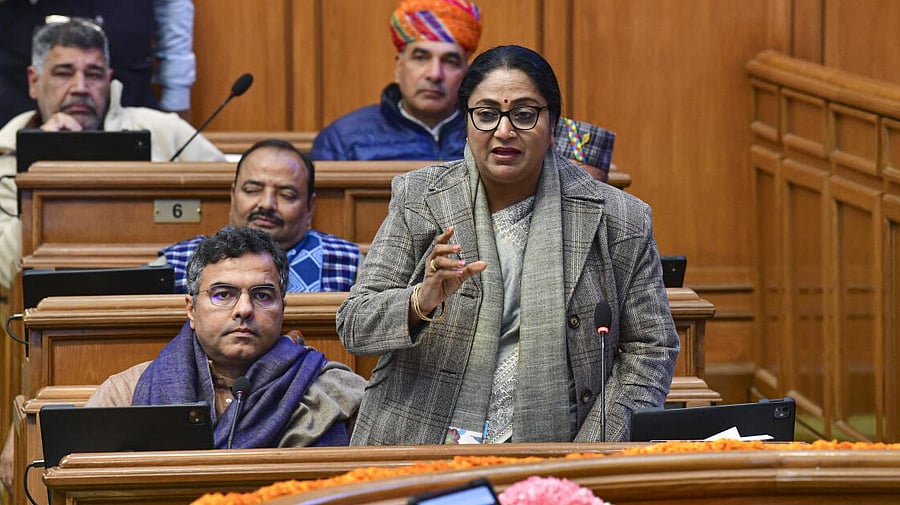
Delhi Chief Minister Rekha Gupta.
Credit: PTI
New Delhi: A "handful of people" behind incidents such as those reported at Jawaharlal Nehru University cannot challenge the sentiments of crores of Indians, Delhi Chief Minister Rekha Gupta said while taking part in a debate in the Assembly to mark the 150th anniversary of Vande Mataram.
Referring to a purported video of a protest at JNU, where slogans were raised against Prime Minister Narendra Modi and Union Home Minister Amit Shah, Gupta said such voices do not represent the country.
"Can a fistful of people challenge the voices and sentiments of crores of Indians? They cannot," she said.
On January 5, a group of students raised slogans against Modi and Shah on the JNU campus during a protest that was held hours after the Supreme Court refused to grant bail to Umar Khalid and Sharjeel Imam, both ex-JNU students, in the 2020 riots conspiracy case.
However, the JNUSU said, the event -- A Night of Resistance with Guerrilla Dhaba -- was organised at Sabarmati Dhaba to mark the January 5, 2020, violence in which a mob of masked people entered the campus and attacked students and teachers with sticks and rods.
Gupta said, "Vande Mataram stands above politics and reflects a nationalist ethos. "Unfortunately, some people see it only through a political lens." She added that the song celebrates the glory of India, its land and its people.
She alleged that some sections focus only on the country's shortcomings and miss no opportunity to speak ill of India, even on international platforms.
The chief minister said the discussion on the national song in the Assembly during its 150th year was significant.
She recalled that during the 100th anniversary of Vande Mataram, the country was under the Emergency, an "unfortunate chapter" in India's democratic history, due to which the song did not receive due honour.
Gupta said that under the leadership of Prime Minister Narendra Modi, the country is progressing on the principle of "Vikas Bhi, Virasat Bhi" -- development along with heritage. India, she said, was gradually emerging from a colonial mindset and moving towards the vision of a developed nation.
Tracing the history of the song, she said Vande Mataram was composed by Bankim Chandra Chatterjee in 1875 and later included in his novel Anandamath in 1882. She emphasised that the song is not associated with any religion, sect, class or political ideology, but symbolises the bond between the motherland and her children.
Gupta said the country was witnessing an ideological struggle that could not be fought with weapons but through national consciousness, of which Vande Mataram is a powerful expression.
She expressed confidence that the youngsters would play a leading role in nation-building.
Delhi Assembly Speaker Vijender Gupta said that while the Assembly traditionally begins its sessions with the national song, only two stanzas have so far been sung. To mark the 150th anniversary, he proposed that the complete song be sung in the House.
He also directed the Secretariat to make the full song available on the desktops and iPads of all members.
Education Minister Ashish Sood said that a song, which colonial rule attempted to suppress in its 50th year and which faced repression during its 100th year, was today being honoured in its 150th year by the Delhi government under the leadership of the chief minister.
He said Vande Mataram transcended regional boundaries and reflected the spirit of "Ek Bharat-Shreshtha Bharat".
AAP MLA Gopal Rai said Vande Mataram inspired generations of freedom fighters to sacrifice their lives for the country.
He said every citizen, irrespective of caste, religion or background, must come together to uphold the spirit of the national song.