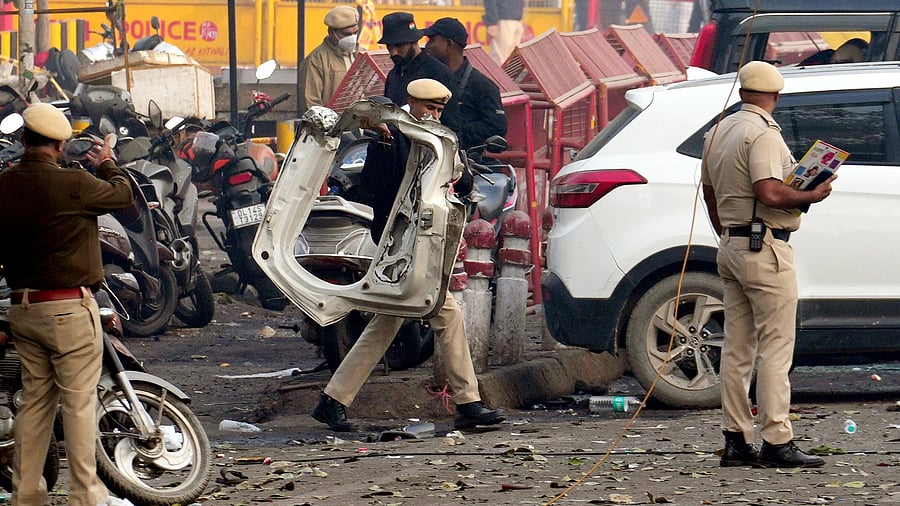
Police personnel at the blast site near the Red Fort Metro Station in Delhi.
Credit: PTI Photo
Srinagar: The Red Fort car bomb blast investigation has entered a decisive phase with the National Investigation Agency (NIA) arresting a key Kashmiri conspirator from Delhi and uncovering a network of radicalised professionals who allegedly planned a series of high-impact attacks across states, officials said.
The anti-terror probe agency on Sunday arrested Amir Rashid Ali, a resident of Samboora in Pampore, who had travelled to Delhi last year to help procure the vehicle used as a car-borne improvised explosive device (IED). Forensic analysis has confirmed that the driver who perished in the blast was Dr Umar Un Nabi, a young Pulwama-based medical professional working as an Assistant Professor at Al-Falah University in Faridabad.
Investigators believe the two had been in touch for months, quietly assembling the logistics for the November 10 attack that killed 10 people and injured 32 near the Red Fort.
‘White-collar’ radicalisation trail
What began as the terror poster case in mid-October has now widened into an unprecedented case of radicalisation among medical professionals, with agencies saying that the module operated with academic identities by day and plotted terror logistics by night.
According to officials familiar with the probe, Umar was part of a close-knit group of doctors and academics who allegedly embraced an extreme ideology over the last three years. The NIA and J&K Police have pieced together a shadowy timeline: a trip to Turkey in 2021, discreet meetings in masjids across south Kashmir, and a quiet but systematic procurement of chemicals such as ammonium nitrate, sulphur, and potassium nitrate.
More than 360 kg of material—acquired from regular market sources and stored in makeshift facilities around the Faridabad university—was recovered earlier this month, pointing to a scale of preparations far beyond a single strike.
From a poster case to interstate conspiracy
The contours of the network surfaced unexpectedly last month when Srinagar Police investigated Jaish-e-Mohammed posters appearing on walls in Bunpora, Nowgam. CCTV analysis led to three local arrests—each with prior involvement in street violence—and subsequently to the detention of an Imam from Shopian who, investigators say, had ties to the radicalised medical circle.
That thread eventually intersected with the Delhi blast probe, prompting J&K Police, Haryana Police and central agencies to work in parallel.
Officials say the most chilling detail that has emerged is the module’s prolonged search for a suicide attacker—an element they considered essential to stage high-impact operations. While Umar allegedly pushed this line more aggressively than others, at least one young recruit approached for the role is understood to have backed out months ago, citing financial stress and religious hesitation.
With Umar now confirmed as the man behind the wheel of the explosive-laden vehicle, investigators are examining whether he chose to carry out the attack himself after the original plan collapsed.
Probe widens across states
The NIA has questioned 73 witnesses so far, seized an additional vehicle belonging to Umar, and is tracking digital, financial and travel footprints across Kashmir, Delhi, Haryana and Uttar Pradesh. Agencies believe the module may have been preparing for multiple attacks, including timed strikes around high-sensitivity dates.
With one conspirator arrested, another dead, and several suspects detained in Kashmir, the hunt is now focused on identifying the larger ring of motivators, facilitators and funders behind what officials describe as one of the most sophisticated “white-collar terror ecosystems” uncovered in recent years.