
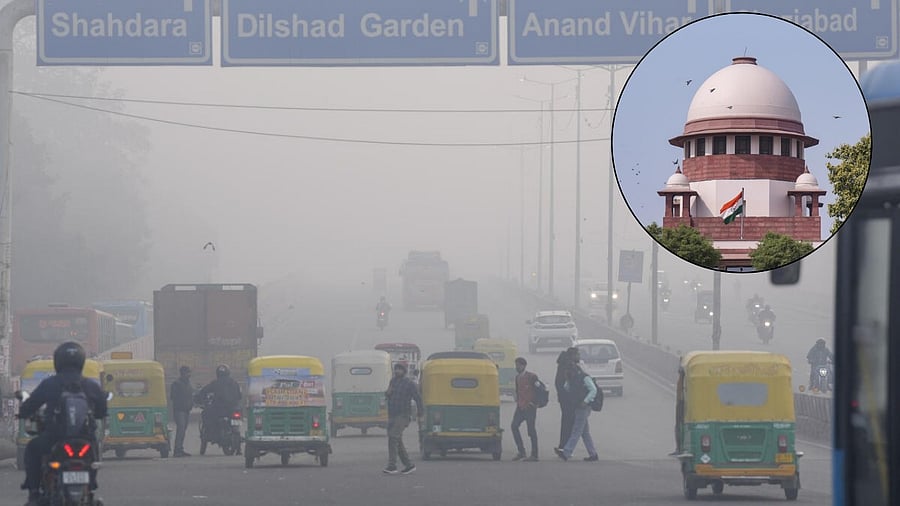
Delhi pollution, Supreme Court.
Credit: PTI Photo
New Delhi; The Supreme Court on Monday said that it will hear on Wednesday the Delhi pollution matter and pass appropriate orders, which would be "realistic, enforceable, and capable of actual compliance."
A bench led by Chief Justice of India Surya Kant said that courts would refrain from issuing orders that cannot be effectively implemented on the ground, as the court was informed that there was deteriorating level of Air Quality Management (AQI) in the Delhi-NCR.
Senior advocate Aparajita Singh, acting as amicus curiae said, that many schools in Delhi-National Capital Region are finding ways to circumvent the court's direction. She said open sports activities must not be held during November-December.
"In spite of this court's earlier direction, during this severe pollution, certain schools have found ways and means to have these sporting activities. So now children are also not being spared. What has been prohibited by this court, all those very activities are taking place," she said.
Singh also said that the Commission for Air Quality Management (CAQM) has also issued a notification barring sporting activities during this period.
The bench said, the court would hear the matter on Wednesday.
"The judicial directions in the Delhi air pollution matter must be realistic, enforceable, and capable of actual compliance," the bench said.
The court also said that lifestyle-related directions are often difficult to enforce. It said, the burden of pollution disproportionately affects the poor, while the problem largely arises from the practices of the affluent class.
The court also added that while passing any order, the impact on poor people will have to be seen, when it was informed by the amicus that with the enforcement of GRAP-IV measures, construction workers are now left without work.
The court also told the lawyers, who have filed applications, to point out their issues, suggestions and inputs to the amicus to save time. The bench also cautioned the counsel and other stakeholders in the matter that they should not go to the press and try to solve these through media.
"Don't try to file applications only for media purposes. The court's time is limited. So we will hear the issue on specific points," the court told the counsel.