
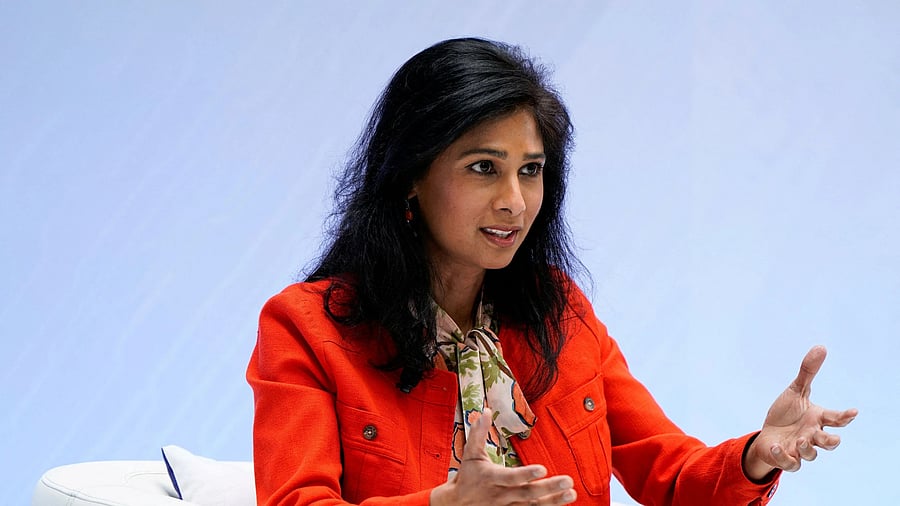
First Deputy Managing Director of the International Monetary Fund Gita Gopinath.
Credit: Reuters photo
New Delhi: Well-known economist Gita Gopinath has told the Parliament’s ‘ONOE’ panel that simultaneous polls to Lok Sabha and Assemblies could reduce election costs but warned that it could face “heavy logistical pressures” and “unusually high staffing needs” citing the example of 2024 Indonesian polls.
Her advice was to undertake a systematic analysis of the experience of states – Andhra Pradesh, Odisha, Arunachal Pradesh, and Sikkim – that currently hold simultaneous elections, as it would provide a useful assessment of logistical challenges, cost-effectiveness, and help share best practices across states.
In her written submission to the Joint Committee of Parliament, she said ‘ONOE’ (One Nation, One Election) could “reduce uncertainty and foster economic activity” as well as “increase” long-term infrastructure investment while emphasising that she views simultaneous polls as a “positive reform” from an economic standpoint.
However, she said the exact costs of implementing simultaneous elections remain uncertain and logistical challenges of synchronising elections should not be underestimated, as underscored by Indonesia’s recent experience under fully simultaneous elections.
Gopinath, IMF First Deputy Managing Director, said Indonesia last year faced “record spending, heavy logistical pressures, and unusually high staffing needs”, culminating in a Constitutional Court directive to partially separate elections from 2029. She will be appearing before the panel on Wednesday.
“While India’s geography and administrative strengths – including robust identification infrastructure – may mitigate some pressures, there remains uncertainty as to the logistical process of synchronization and the net cost effects,” she said.
A well-evaluated implementation will be essential to ensure that the reform becomes a sustainable model – one that contributes to long-term economic stability and growth, she said adding that it is also essential to address the “significant political and constitutional questions surrounding ‘ONOE’ such as its impact on federalism and the balance of power”.
Emphasising that ONOE could reduce uncertainty and foster economic activity, she said studies show pre-election uncertainty tends to slow investment as international firms cut investment in countries in national election years.
In the Indian context, she said this is reinforced by the Model Code of Conduct, which freezes new public projects during staggered state and national polls.
“By reducing the number of separate election windows, synchronisation can reduce periods of uncertainty for both firms and ministries, thereby enabling steadier procurement and investment planning. This pattern is supported by evidence of stronger post-election growth in states with simultaneous elections,” she said.
Gopinath also said election periods in India are often marked by short-term fiscal spending – typically in the form of subsidies or 'freebies' – that crowd out longer-term infrastructure investments.
“International evidence mirrors this dynamic: governments commonly increase public deficits in election years, and later offset this spending with cuts to capital investment. This shift matters for growth, as capital spending in India generates roughly 2.5 times the GDP returns than transfer programs. By reducing the frequency of elections, synchronised elections could help shift public spending towards infrastructure investment and contribute to longer-term economic growth,” she added.