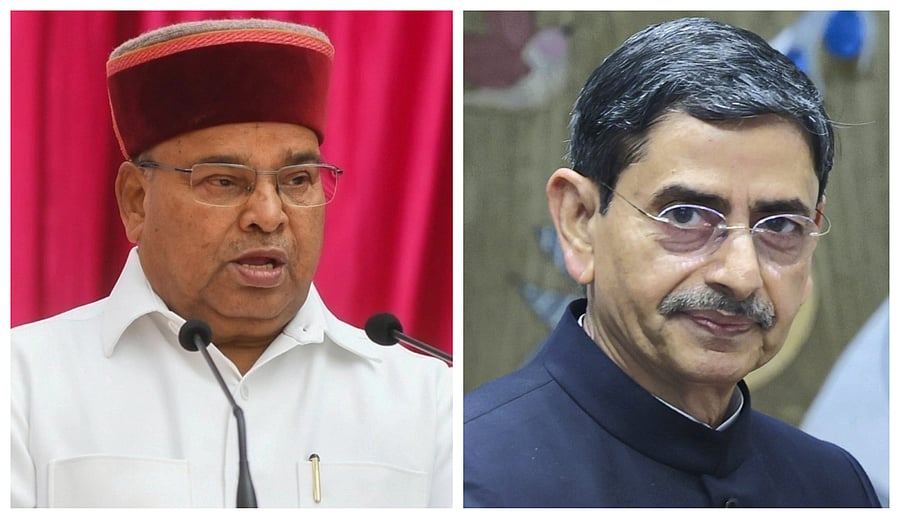
Karnataka Governor Thaawarchand Gehlot and (R) Tamil Nadu Governor R N Ravi
Credit: DH and PTI File Photos
The confrontation between the Lok Bhavans (formally Governor houses) and non-BJP ruled State governments have come to a head over differences in the Governor's address to the State legislature. DH explains the mandate and powers vested on the Governors and the State Cabinet in deciding the speech made at the beginning of the first session of the year.
How does the Constitution define the powers of the State legislature?
Schedule 6 of the Constitution (Article 152 to 237) deals with the State legislature and executive in India’s federal polity. State executive comprises the Council of Ministers with the Chief Minister as its head and the Governor, who is an appointee of the President.
Depending on whether the State has a unicameral or bicameral polity, the Assembly alone or together with the Council, as the case may be, and the Governor, constitute the State legislature.
Except in matters where he is mandated to exercise his discretion as per the Constitution, the Governor functions on the aid and the advice of the Council of Ministers headed by the Chief Minister (Article 163).
What are the powers of the Governor in convening a session of the State legislature?
Article 174 empowers the Governor to summon the House or Houses “to meet at such time and place as he thinks fit”. In a landmark judgement on the powers of Aruanchal Pradesh Governor (Nabam Redia case-2016), a 5-member bench of the Supreme Court adjudicated that the Governor’s discretion under this Article did not extend to summoning the House or Houses and he has to go by the advice of the State Council of Ministers.
What does the Constitution say on the Governor’s address to the State legislature?
Articles 175 and 176 deal with the Governor’s address to the State legislature. The first empowers the Governor to address or send messages to the legislature. Subsequently, Article 176 says, at the commencement of the first session after Assembly polls and at the commencement of the first session of each year, the Governor “shall address the Legislative Assembly or, in the case of a State having a Legislative Council, both Houses assembled together and inform the legislature of the causes of its summons”.
How have courts dealt with the Governor’s address to the State legislature?
In 1966, the Rajasthan High Court ruled that partial speech by the Governor could be deemed as address to the legislature as the “essence of the matter in the address was the Governor coming into direct and immediate communication with representatives of the people”.
The Calcutta High Court, in a similar case (Syed Habibullah vs Speaker of West Bengal Assembly) said the address by the Governor at the commencement of session was not just directory, but mandatory. The court, however, felt laying of or delivery of a partial speech can be seen only as an irregularity and not illegality. Hence, under such circumstances, the summoning of the House and its subsequent proceedings are deemed to be legal.
Has a State Assembly started a Budget Session without the Governor’s address?
In 2022, the Telangana Assembly started Budget Session without the Governor’s address. The BRS government led by K Chandrashekhar Rao did not prorogue the House after last session of previous year. The Budget session was deemed a continuation of previous session and so, did not mandate the Governor’s address.
Can the Governors make changes to the speech cleared by the state council?
This has been an issue of intense political and legal debate. Governors are bound by the aid and advice of the state council of ministers. The speech at the beginning of the budget session outlines the policies, and programmes of the state government. An alteration could render the speech, which has to be discussed and ratified by the legislature, politically indefensible for the state government, leading to a constitutional crisis.