
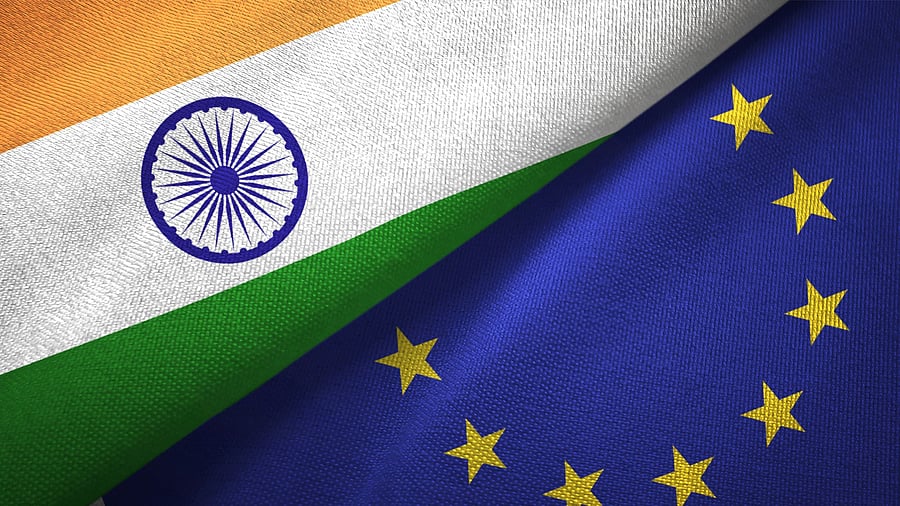
The flags of India and the European Union (EU).
Credit: iStock Photo
New Delhi: India is likely to join a programme the European Union launched to provide a framework for the members of the bloc to jointly develop defence capabilities, invest in shared projects, and enhance the operational readiness of their armed forces.
President Droupadi Murmu and Prime Minister Narendra Modi were joined by the European Council President António Luís Santos da Costa and European Commission President Ursula von der Leyen in witnessing the Republic Day parade on the Kartavya Path in New Delhi on Monday.
The EU leaders confirmed the keenness of the bloc in deepening of the defence and security cooperation with India.
Though the EU launched its Permanent Structured Cooperation (PESCO) for its members in 2017, it was opened up for non-members in November 2020, and Canada, Norway and the United States already joined the programme.
The defence and security partnership with the EU is likely to set the stage for India to participate in the PESCO. New Delhi, however, will have to work out a Security of Information Agreement (SOIA) with the 27-nation bloc.
PM Modi will join da Costa and von der Leyen in chairing the 16th India-EU summit in New Delhi on Tuesday.
The leaders are expected to announce the launch of the defence and security partnership between India and the EU.
“The display of the flags of the EU, the EU Military Staff, and our maritime missions ATALANTA and ASPIDES at India’s Republic Day is a powerful symbol of our deepening security cooperation,” von der Leyen posted on X. “It will culminate tomorrow in the signature of our Security and Defence Partnership.”
The Operation Atalanta, which was originally launched as European Union Naval Force (EU NAVFOR) Somalia in December 2008, is a counter-piracy military operation at sea off the Horn of Africa and in the Western Indian Ocean. It is the first naval operation conducted by the EU.
The Operation Aspides, a.k.a. EUNAVFOR Aspides, is an EU military operation launched on February 19 in response to multiple offensives launched by the Houthi rebels of Yemen on the international shipping lanes in the Red Sea.
“Good to see a contingent representing the European Union, led by Colonel Spruijt, acting on behalf of the EU Military Staff, at the #RepublicDay parade (of India),” da Costa posted on X, adding, “An opportunity to recall the importance of the action of the EU Naval Forces Atalanta and Aspides to enhance maritime security and protect the freedom of navigation, in particular in the Indo-Pacific (region).”
The PESCO, from 2018 to 2025, has generated a total of 83 collaborative projects spanning the five operational domains of land, maritime, air, space, and cyber. While eight have closed, 75 are still ongoing, according to the EU.
The projects have ranged from protecting space assets to monitoring undersea infrastructure. The European Defence Agency (EDA), which is part of the PESCO secretariat, believes the projects encourage a shared, intergovernmental approach to defence planning.
All 26 participating EU Member States have taken part in various initiatives, working together to address capability gaps and fulfil their more binding commitments set out in PESCO.
A non-EU country like India applying for participation in a PESCO project must share the values on which the EU is founded, must not contravene the security and defence interests of the EU and its member states, and must have an SOIA with the EU for the exchange of classified information.
The 16th India-EU summit in New Delhi will also see progress on the SOIA.