
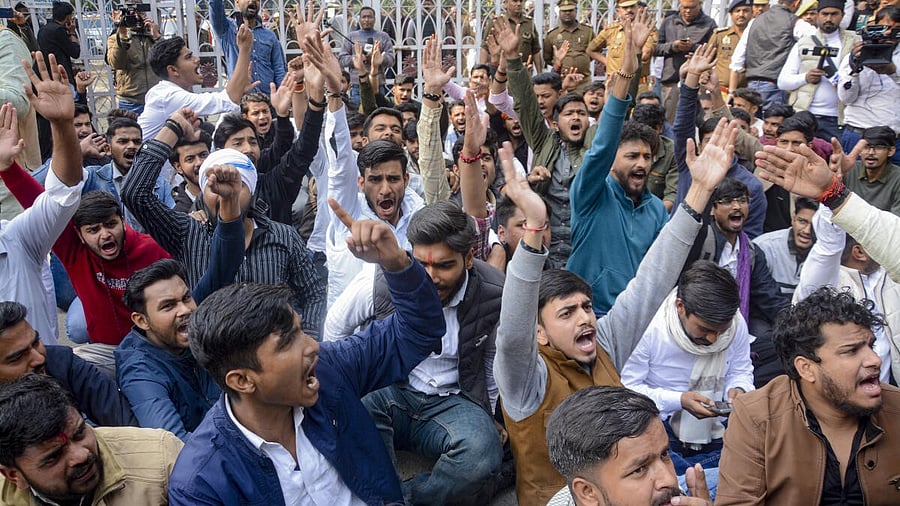
Students staging a protest against the new University Grants Commission regulations.
Credit: PTI Photo
The University Grant Commission (UGC) has announced new rules to curb caste-based discrimination faced by reserved category students on college campuses.
The new rules direct all higher education institutions (HEIs) to form a campus committee to address complaints and issues related to caste-based discrimination and ensure equity across the institution.
What Equal Opportunity Centre do?
As per the new Equity Regulations, all HEIs are mandated to set up an Equal Opportunity Centre (EOC) which will address discrimination-related issues on campus and work towards inclusion and support for disadvantaged groups in colleges and universities.
The body must also coordinate with civil society groups, local media, police, district administration, non-governmental organisations (NGOs), faculty members, staff, and parents to ensure that no discrimination takes place on a university campus.
It must also ensure inclusion and participation of other backward classes (OBCs), Scheduled Castes (SCs), Scheduled Tribes (STs), persons with disabilities (PwDs), and women in campus activities.
How is equity defined?
According to the new rules, "caste-based discrimination" has been defined as as discrimination “only on the basis of caste or tribe” against members of the SCs, STs, and OBCs.
'Equity' has been defined as providing a level-playing field for all stakeholders in terms of rights and opportunities.
Who will be held responsible for flouting the norm?
Equity Squads have been given the responsibility of monitoring vulnerable spaces on campus. Additionally, Equity Ambassadors will act as points of contact in hostels, departments, and libraries.
HEIs must also ensure preventive and protective measures, including setting up of helplines numbers, monitoring systems, and regularly reporting to the UGC.
The responsibility to implement these new rules has been given to institution heads, including vice chancellors and principals. They are required to ensure compliance and submit reports to the UGC.
HEIs that do not comply with the new guidelines could be penalised heavily. This could include denial of approval for academic programmes, exclusion from UGC schemes or even withdrawal of recognition.
Why did the UGC introduce new rules?
According to the regulator, caste-based discrimination is on the rise on college and university campuses. Complaints of caste-based discrimination increased 118.4 per cent in five years, from 173 cases in 2019–20 to 378 in 2023-24. A total of 1,160 complaints were received from 704 universities and 1,553 colleges during this period.
The UGC cited this data to highlight the need for stronger protection for oppressed castes on HEI campuses.
The regulations come after an order from the Supreme Court linked to a petition on the implementation of the 2012 UGC anti-discrimination rules.
The petition was filed by the mothers of Rohith Vemula and Payal Tadvi.
Rohith Vemula was a PhD scholar in the University of Hyderabad. He died by suicide in 2016 due to alleged caste-based harassment.
In 2019, Payal Tadvi, a resident doctor at Mumbai's Topiwala National Medical College and BYL Nair Hospital, died by suicide due to similar circumstances.
New rules trigger protests
The new rules have triggered protests from 'upper' caste or general category students. They say that no separate provisions have been made for them.
The protests at the UGC headquarters are being led by the 'Savarna Sena'.
Protesters at the UGC headquarters also alleged that the regulations could lead to an increase in complaints from reserved category students. The regulations and the protests against them have drawn responses from both government and student bodies. The All India Student Association has also issued a statement on the issue.
The protesters have alleged that general category students or others, apart from reserved category candidates, cannot raise their complaints and that there are no clear provisions for them to raise issues.
Further, they claim that the new rules could increase inequality instead of promoting equality.
What has the government said?
The government has now said that provisions for general category students would be be added to the Equity Regulations so that their complaints and allegations could also be addressed.
BJP MP Nishikant Dubey said on social media that “all misconceptions” about the new regulations would be addressed.
Matter reaches Supreme Court
A plea has been filed in the Supreme Court against the new UGC equity guidelines.
Advocate Vineet Jindal has filed the petition, arguing that regulation 3(c) of the UGC rules is “non-inclusionary” and fails to protect students and faculty who are not from reserved categories.
He added that the current rules deny the protection and grievance redressal to persons belonging to non-SC/ST/OBC categories.