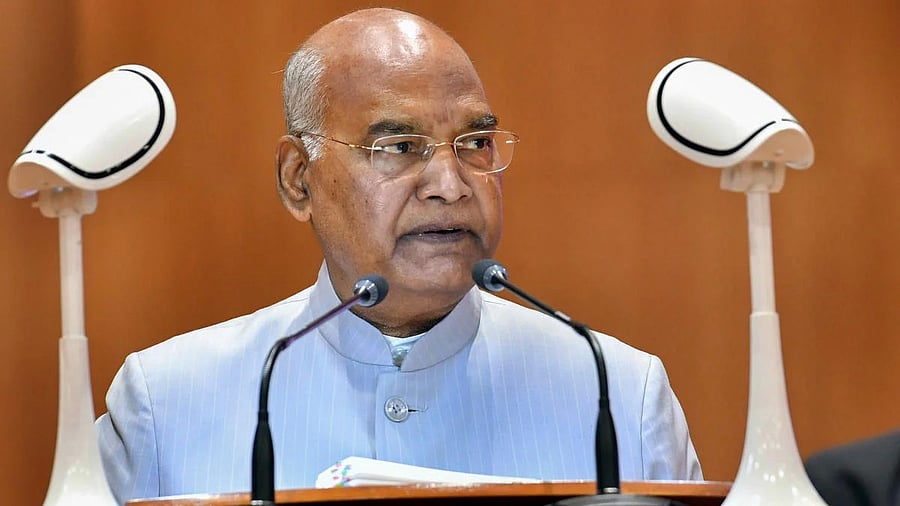
Former President Ram Nath Kovind.
Credit: PTI Photo
Bilaspur: Former President Ram Nath Kovind on Thursday said the 'One Nation, One Election' concept will be a "game-changer" for the country's development and also benefit the education system as frequent polls put a great burden on teachers.
Kovind, who headed a high-level committee on simultaneous elections, was talking to reporters in Raipur before attending the 6th convocation of Atal Bihari Vajpayee University in Chhattisgarh's Bilaspur district as chief guest.
Simultaneous elections would save administrative resources and prevent frequent disruptions to the education system, he said.
Replying to a question, Kovind said the committee headed by him submitted its report to the President, following which the government introduced two Bills in the Lok Sabha in 2024. Both the bills have now been referred to the Joint Parliamentary Committee which is examining them, he said.
Frequent elections across states every year put a heavy burden on the administrative machinery, especially teachers, Kovind noted.
"I want to tell the people in the country through the media that if this concept is introduced, it will prove to be a game-changer. A game-changer for India's development," he said.
Under the present system, elections are held in four or five states across India every year, and the entire administrative machinery gets involved. "Children's education becomes a casualty, because teachers are roped in for election work and can not devote time to teaching," the former president said.
During the committee's interactions, it was seen that the people are inclined to accept simultaneous elections, said Kovind.
In his convocation speech later, the former president said the students should move forward with the rapidly changing world while remaining connected to their rich cultural heritage.
India today stands as a "Guru" in the world for Yoga, he said, and urged them to adopt yoga and physical exercise for a healthy body and mind.
"A healthy mind and body help build confidence," he said.
He also urged the students to help the underprivileged, calling it an important contribution to nation-building.
"The daughters of our country are marching shoulder-to-shoulder with its sons. Here, girls have secured 52 gold medals today, while boys secured only 14. In percentage terms, girls claimed 78% of the gold medals," Kovind noted.
Some of the women students received multiple gold medals, which was a reflection of an "emerging India", he said.
Recalling his own journey which began in a village school, Kovind said education transformed his life and enabled him to reach Rashtrapati Bhavan.
He used to walk barefoot for six km to attend high school because his village near Kanpur had only a primary school, he said.
"My feet would burn in the summer, but I didn't give up, and graduated. This was at a time when financial constraints meant I could not even afford a uniform," Kovind said.
His autobiography, to be published in February, will trace this journey from a small village to the highest office of India, he said.
Kovind also encouraged the graduates to continue upgrading their knowledge and skills, stressing the importance of self-management, emotional intelligence and a positive mindset.
Chhattisgarh Governor Ramen Deka, Chief Minister Vishnu Deo Sai, Deputy Chief Minister Arun Sao and Higher Education Minister Tank Ram Verma were present at the convocation.