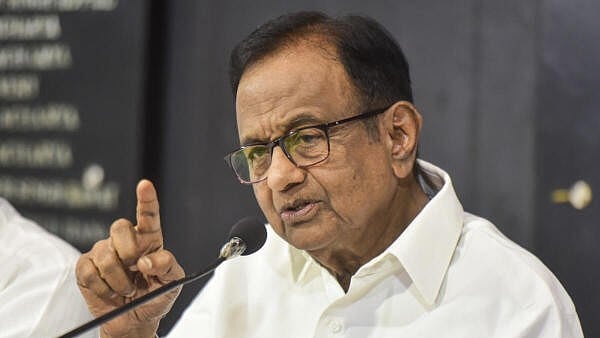
Congress leader P Chidambaram
Credit: PTI Photo
Chennai: Senior Congress leader P Chidambaram on Sunday said that the removal of Mahatma Gandhi’s name from the MGNREGA is the "second killing of Mahatma Gandhi".
The Congress will continue to protest till the previous rural employment guarantee scheme is restored, he said.
"The party will expose this fraud by going from house by house, village by village, and our struggle will continue until this Act is repealed," he said addressing a press conference here.
The Parliament on December 18, passed the Viksit Bharat Guarantee for Rozgar and Ajeevika Mission (Gramin) (VB-G RAM G Bill), that seeks to replace the 20-year-old Mahatma Gandhi National Rural Employment Guarantee Act (MGNREGA) and guarantee 125 days of rural wage employment every year.
"According to me, it's the second killing of Mahatma Gandhi. He was killed once on January 30,1948. They have killed him again -- they have killed his memory again," the former union finance minister said.
"You can try to erase Gandhi and Nehru from official records, but they live in the deep consciousness of the Indian people, like the Buddha or Jesus. No government order can wipe them out," he added.
Chidambaram said the changes by the Centre converted a "demand-driven entitlement into a discretionary scheme", thereby depriving the rural poor of guaranteed employment.
"Under the original law, if a person demanded work, the government was legally bound to provide it. Now, people can only ask for work if the government first offers it," he said.
The senior Congress leader also questioned the government’s decision to use what he called "Hindi words written in English letters" for new programme titles. He said names such as "Viksit Bharat G Ram G" were confusing and unintelligible for rural south Indians.
"Even ministers may not understand what these names mean. The law now says that unless states use this exact name, they will not receive funds," he said.
Chidambaram contended that the scheme -- once universal -- would now be limited to "notified districts" selected by the Centre. Unlike MGNREGA’s original framework that extended to every rural district, the new version, was no longer national in scope and would not cover urban or town panchayat areas, he claimed.
The senior leader alleged that the funding responsibilities were being pushed onto the states. Earlier, the Centre met the full wage cost and 75 per cent of material expenses; the new policy, he said, offers a "normative allocation" after which states must contribute based on their "economic capacity".
"If a state says it doesn’t have the funds, the scheme will simply not be implemented there," he cautioned, noting that budgetary support had also dropped sharply.
"Four years ago, the allocation was Rs 1,11,000 crore. For the past three years, Rs 86,000 crore. Next year, it is only Rs 65,000 crore. Any cost above Rs 65,000 crore is the state government’s responsibility," he noted.
Chidambaram said the rollback of MGNREGA would hit the "ultra-poor" the hardest, particularly daily wage earners and women.
"The scheme is a safety net for 12 crore people who depend on daily wages. In Tamil Nadu, 90 to 95 per cent of workers are women; they will suffer the most," he said.
He also dismissed the Centre’s claim that it would increase workdays to 125 as "unrealistic," pointing out that the national average currently stood at 50 days, with only a fraction of workers completing the stipulated 100 days.
Recalling that the original Act was passed unanimously in Parliament in 2005 with the BJP’s support, he noted that Prime Minister Narendra Modi had once termed MGNREGA a "living monument" of the UPA’s failures. "Now the same government is dismantling it," he said.