
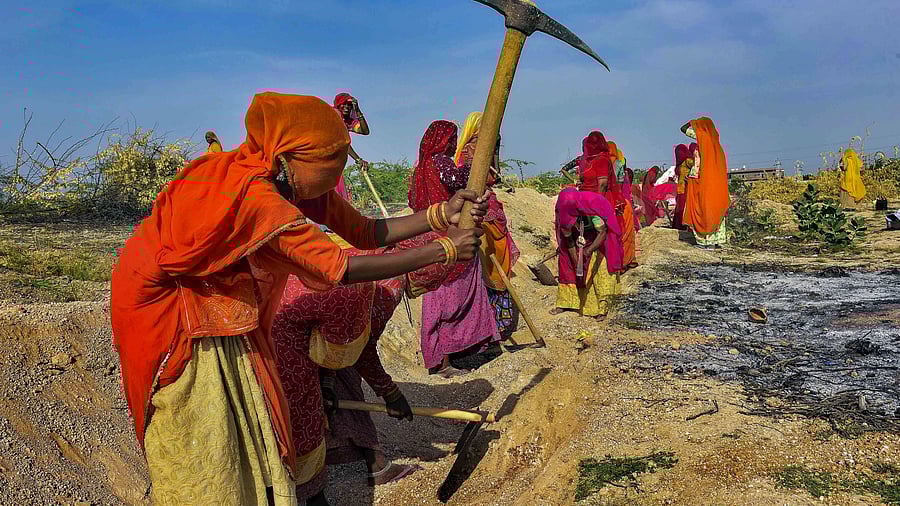
Women labourers enrolled under the Mahatma Gandhi National Rural Employment Guarantee Act working at a field in Bikaner.
Credit: PTI File Photo
New Delhi: The Modi government is set to introduce in parliament a new rural employment guarantee law- the Viksit Bharat Guarantee for Rozgar and Ajeevika Mission (Gramin) (VB-G RAM G) Bill, 2025, which aims to scrap the Mahatma Gandhi National Rural Employment Guarantee Act, 2005 (MGNREGA), and proposes major changes in its funding mechanism.
Under VB- G RAM G, the states will have to share the financial burden for the implementation of the rural job guarantee program, while MGNREGA was an entirely centrally funded scheme.
The bill, which was passed by the Union Cabinet last week, proposes that the Centre and states will share costs in a 60:40 ratio for all states and Union Territories with legislatures.
However, for North-Eastern and Himalayan states, the funding pattern will remain 90:10 between the Centre and the states. Union Territories without a legislature: 100% funded by the Central government.
The MGNREGA, which was passed as the National Rural Employment Guarantee Act in 2005 by the Manmohan Singh-headed UPA government, was renamed in 2009, though the provisions of the statute remained largely unchanged except for the scope of work that could be conducted under the program.
At present, as per the MGNREGA framework, the Central Government bears the full cost of wages for unskilled manual work, up to three-fourths of material costs, and three-fourths of wages for skilled and semi-skilled workers. While the new Bill alters the funding structure, it retains the existing wage rates as notified under Section 6 of the MGNREGA.
As per proposed legislation, it will be a centrally sponsored scheme, and every state government will have to prepare a scheme for giving effect to the guarantee proposed under this bill, within a period of six months from the date of the implementation of the Act.
The Centre would make an allocation for each state, to be estimated based on certain parameters. Further, expenditure in excess of the approved normative allocation shall be the responsibility of the state governments.
The Bill, for the first time, bans VB G RAM- G-related works in the agricultural seasons. The Bill empowers states to notify specific periods covering sowing and harvesting seasons during which works under the scheme will not be undertaken, to ensure adequate availability of farm labour.
The scheme will be managed by a Central Gramin Rozgar Guarantee Council, formed by the Union government.
Earlier, MGNREGA would be handled directly by the rural development ministry without any special council or body.
The Central Government will also form a National Level Steering Committee to recommend decisions relating to normative allocations to States and to advise on matters requiring inter-ministerial consultation, including convergence framework and to provide high level oversight for the effective implementation of this Act. The states too, will have steering committees.
The scheme allows the panchayats at the district, intermediate and village levels to be the principal authorities for implementation of the Scheme made under this Act and District Programme Coordinators will be appointed for the implementation of the Scheme.
The VB-G RAM G Bill proposes to establish a “rural development framework aligned with the national vision of Viksit Bharat @2047, by providing a statutory guarantee of 125 days' wage employment in every financial year to every rural household from an existing 100 days.