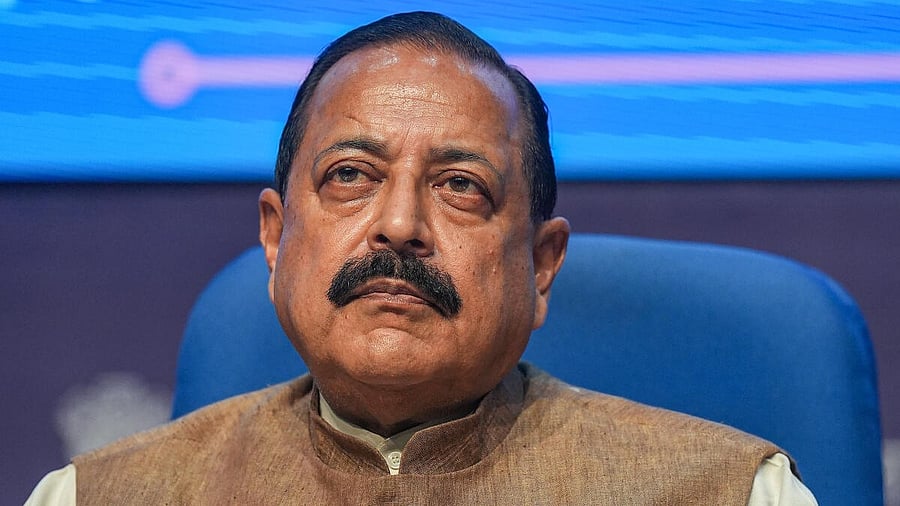
Union Minister Jitendra Singh.
Credit: PTI Photo
New Delhi: Union minister Jitendra Singh on Monday called for stronger efforts to adopt Hindi across government establishments, noting that practical use of the language in official work is key to its growth and relevance.
Chairing a meeting of the Hindi Advisory Committee of the Department of Personnel & Training (DoPT), he said that no language can develop sustainably unless it is linked with employment, underlining the importance of Hindi as a functional and communication tool in governance.
Singh, the Minister of State for Personnel, emphasised that the growth of Hindi should not come at the expense of other Indian languages.
Appreciating the linguistic discipline of several officers from southern states who use precise Hindi in documentation, he said that both Hindi and regional languages must be strengthened to preserve diversity while creating inclusive communication frameworks.
Singh said that there has been a visible change in the language ecosystem over the past decade in government institutions.
The minister said that the usage of Hindi in central departments has grown steadily, with the language increasingly chosen for administrative documents, communication and training material.
Singh said that greater use of Hindi should be encouraged while balancing workload realities.
The minister remarked that regions previously perceived as outside the Hindi linguistic sphere, including Mizoram, are now witnessing rising demand for Hindi education and communication.
He shared examples of recruitment preferences in service sectors where working knowledge of both English and Hindi is increasingly viewed as an advantage.
Singh said that the shift reflects broader societal and professional trends, especially with expanding job opportunities in sectors where dual-language skills improve employability.
Launching three publications during the meeting — Kaushal of the DoPT, Sopan of the Department of Pension & Pensioners' Welfare, and Karnatak Ki Shreniyaan, authored by advisory committee member Ambuja Malkhedkar — the minister said that knowledge-driven Hindi literature must grow further in areas such as administration, science, and technology.
Committee members presented a range of proposals, including increasing Hindi in departmental proceedings, encouraging science communication in Hindi, and expanding digital content through social media. They also highlighted the availability of technical tools and resources through universities to support officials.
The minister also emphasised that the growth of Hindi should not come at the expense of other Indian languages.
Appreciating the linguistic discipline of several officers from southern states who use precise Hindi in documentation, he said that both Hindi and the regional languages must be strengthened to preserve diversity while creating inclusive communication frameworks.
Some members underlined that meaningful linguistic development is possible only when Hindi is linked with employment opportunities, with references to experiences in educational policy and corporate hiring trends over the years, a statement issued by the personnel ministry said.
The minister agreed, noting that language becomes relevant when it unlocks work, learning and mobility, and pointed to emerging demand from parents and communities even in non-Hindi-speaking states, according to the statement.
The meeting ended with a broad consensus on expanding Hindi usage in administration while upholding India's multilingual character.
It reaffirmed the government's intent to deepen the language's presence in governance, ensure accessibility of official information in Hindi and continue dialogue on linguistic practices across ministries and departments, the statement said.