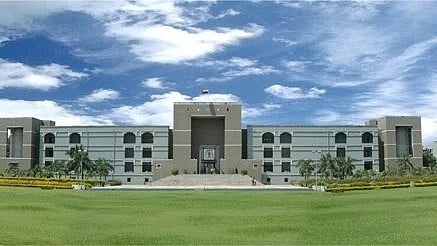
Gujarat High Court
Credit: gujarathighcourt.nic.in
Ahmedabad: In a breather to three doctoral students expelled by the Indian Institute of Management, Ahmedabad (IIMA) for failing to meet the conditions required to continue their course, the Gujarat High Court has quashed the expulsion order, ruling that the decision was "not in consonance with the procedure" and lacked legal authority.
The single bench of justice Nikhil Karial quashed the order of expulsion holding that order of chairperson of the programme "requiring the petitioner to leave the programme is not in consonance with the procedure prescribed in the manual and whereas the same would be an action without any authority of the law that is non est and void ab intio".
The order uploaded on the high court's website recently further added, "Consequently, the order passed by the Director of the institute would also be rendered ineffective and non est."
Three first year Doctoral of Programme in Management or DPM students had been expelled by the institute in June. The institute had asked them to leave the campus after they were declared as not fulfilling the conditions for promotion from the first year to the second year of coursework. The students approached institute's director Bharat Bhaskar who also rejected their appeal, compelling them to move to the high court.
One of the students argued that Sandip Chakrabarti, a subject teacher and the area head (department head), also served as the chairman of both the Student Evaluation Committee and the Executive Committee. These committees were responsible for the decision not to promote the student from the first to the second year due to academic shortfall.
The student contended that "without any personal malafide" against Chakrabarti, his involvement in the decision-making process, both as the area head and in confirming the decision without offering review or remedial measures, created a conflict of interest. It was argued that he should have recused himself from the process as chairman of the Executive Committee.
One of the students was also found involved in "academic dishonesty' by giving references using Artificial Intelligence which turned out to be fake. The student suspected whether she had been expelled "on the ground of academic indiscipline under the guise of expelling her on the ground of academic shortfall."
IIMA responded that the decisions were taken as per the provisions of the manual of DPM. The institute argued that the students were given adequate opportunity to explain the reasons in writing to the Executive Committee which reasons had been taken into consideration while passing the final order deciding not to promote the petitioners and whereas the Director before taking the final decision had given appropriate opportunity of hearing to the petitioners.
The lawyers for the petitioner students, Anand Yagnik and Biju Nair, argued that the first two years of the DPM coursework are preparatory, designed for students who come from diverse backgrounds, many of whom don't have a management background. They contended that any academic shortfall should have been viewed more leniently.
DPM is a full-time residential programme and students are expected to complete the course in four years which can be extended up to six years under certain conditions.