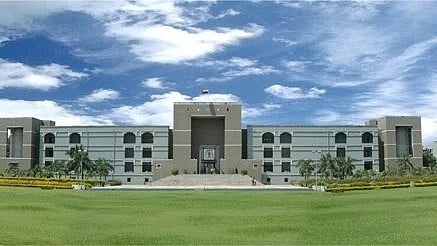
Gujarat High Court
Credit: gujarathighcourt.nic.in
Ahmedabad: In a significant ruling, the Gujarat High Court on Tuesday dismissed a batch of petitions, stating that Waqf institutions are not exempt from court fees when filing cases before Waqf tribunals. This decision means that, like other tribunals, Waqf institutions will be required to pay court fees, which was not the case before.
Gujarat Deputy Chief minister Harsh Sanghavi termed the judgement "historic" while claiming that "previous Congress government had exempted Waqf institutions from paying such fees as part of vote-bank politics."
The single bench of justice JC Joshi has held that the Waqf Tribunal is "deemed to be a civil court and is vested with the same power as exerciseable by civil court" under the Code of Civil Procedure or CPC.
"The statutory scheme clearly envisages that, while the Tribunal (Waqf) may follow any additional or special procedure as may be prescribed, such procedure must necessarily be in consonance with, and not repugnant to, the provisions of the CPC," the judgement reads
It says that section 83 of the Waqf Act empowers the tribunal to decide issues relating to a waqf or waqf property and such tribunal is "expressly deemed to be a Civil Court, being vested with all the powers of a Civil Court under the CPC for the purpose of trying a suit or executing a decree or order."
A number of petitioners, divided into three groups- Sunni Muslim Idgah Masjid Trust, Sidhpur, Sarkhej Roza Committee, Makarba and Vadodara Saher Masjid Sabha Trust, Vadodara. There were three categories of cases initiated before the Waqf tribunal under section 83 (1) of Waqf Act, 1995, seeking recovery of possession of Waqf properties from the tenants and alleged encroachers.
The group approached the high court against the tribunal order which found that Waqf institutions had "neither correctly valued the suits nor affixed the requisite court fees commensurate with such valuation."
In 2024, the tribunal had passed an order directing them to rectify the valuation of the suits and pay deficit court fees. Since the plaintiff Waqf institutions didn't follow the order, the tribunal rejected their applications.
Besides challenging the tribunal's orders that there was no provision of court fee for moving before the Waqf tribunals. The petitioners argued that in the absence of any express statutory prescription or delegated legislation providing for the levy of court fees in respect of proceedings before the Waqf tribunal, any insistence by the State Government or the Tribunal requiring payment of court fees is wholly de hors the statute and, therefore, legally untenable.
The high court, however, held that "the applicability of Section 1(5) of the Gujarat Court Fees Act, 2004, clearly indicates that the said enactment governs the fees leviable in Courts and public offices within the State, in absence of any special law governing issue of levy of court fees."
Deputy chief minister Harsh Sanghavi termed the verdict historic and said that the court ruling has "ensured equality before the law irrespective of religion."
Speaking at a public function, Sanghavi said that during the Congress rule, Waqf tribunals had been exempted from court fees as part of vote bank politics but continued to take fees from other religious institutions including Hindus, Sikhs, among others.