
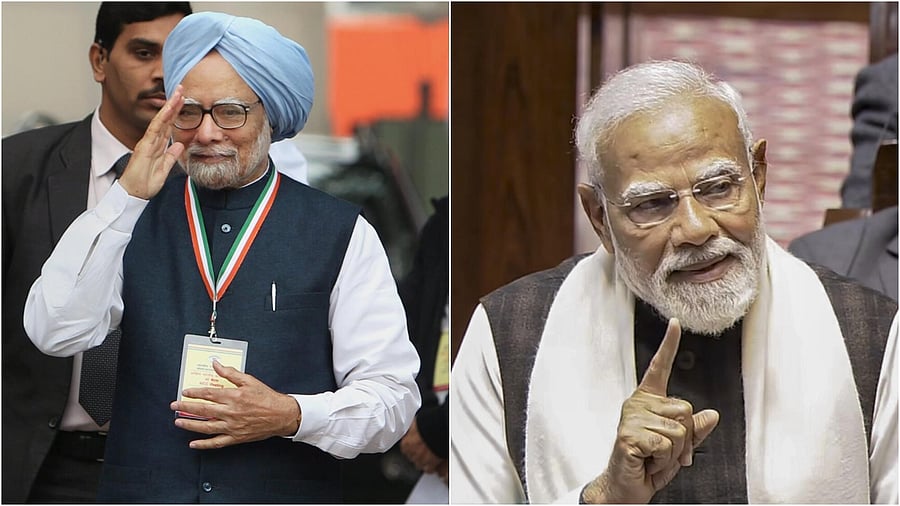
Manmohan Singh (left) and Narendra Modi.
Credit: PTI Photos
New Delhi: This is not the first time that a Prime Minister could not reply to the debate on the Motion of Thanks to the President's Address following Opposition protests.
Manmohan Singh faced the same predicament in 2004, within days of assuming power over inclusion of “tainted ministers”.
Twenty-two years later, Narendra Modi too could not deliver his address after the Opposition said that they will not allow him to speak if Leader of Opposition Rahul Gandhi cannot speak on claims of former Army Chief Gen MM Naravane made in his unreleased memoir against the Prime Minister.
While Singh was present in the House to urge MPs to vote on the motion on June 10, 2004, Modi was absent with Speaker Om Birla saying that he had asked the Prime Minister not to come as he had “concrete information” about Congress MPs engaging in “unforeseen” protests.
Singh had assumed power on May 22, 2004, and APJ Abdul Kalam had delivered the President’s Address on June 7, 2004. The debate started the next day, but the BJP and other parties created a furore over the inclusion of Lalu Prasad, Shibu Soren, Mohd Taslimuddin, Jay Prakash Narayan Yadav, MA Fatmi and Prem Chand Gupta as ministers, alleging that they were “tainted”.
Singh made almost identical appeals in both the Houses as he also could not speak in Rajya Sabha due to protests, “I learn that there is an understanding among the political (parties) on both sides that the Motion of Thanks on the President's Address be put to vote straight away and passed unanimously…I request you to put the motion to vote.”
During his reply to the motion on President’s Address of 2005, Singh referred to the 2004 episode he said, “this is a hard earned privilege for me since I've had to wait out the entire year to perform this happy task. I would like to take this opportunity to doubly thank the President—for his Address last year (2004) and his Address this year (2005).”
Not much debate took place in the three days scheduled for debate in 2004 even as veteran Congressman Pawan Bansal moved the motion and Jyotiraditya Scindia, who would join BJP later, seconded it. Parliamentary records show that only two lawmakers spoke during the debate, which saw intense protest from the BJP and its allies that had lost power.
Parliamentary records showed their speeches lasted for 19 minutes between 11:18 AM and 11:37 AM. “The democratic temper, the lack of which is demonstrated here again today which is so essential for running the affairs of a vast and diverse country like India, was totally missing. There was a perceptible sort of inebriation caused by the trappings of power,” said Bansal.
“It's a mandate to make India a powerful country...we will not be cowed down by this sort of behaviour," Scindia had said. On June 9, amendments were moved.
The records showed that BJP MP VK Malhotra and Trinamool Congress' Mamata Banerjee, who is presently West Bengal Chief Minister, had tried to raise questions against the UPA government.
This time, no Opposition leader could make a full speech during the debate. Samajwadi Party's Akhilesh Yadav and Naresh Uttam Patel, Trinamool Congress' Shatabdi Roy and DMK's Kathir Anand were called to speak after disallowing Rahul, who was raising the Naravane issue, they declined to speak saying the Leader of the Opposition should be allowed.
From the Treasury benches, five members spoke -- Union Minister Sarbanand Sonowal moved the motion while BJP's Tejasvi Surya seconded it as also TDP's GM Harish Balayogi. BJP's Nishikant Dubey also had a small intervention, which riled the Opposition, as also PP Chaudhary.