
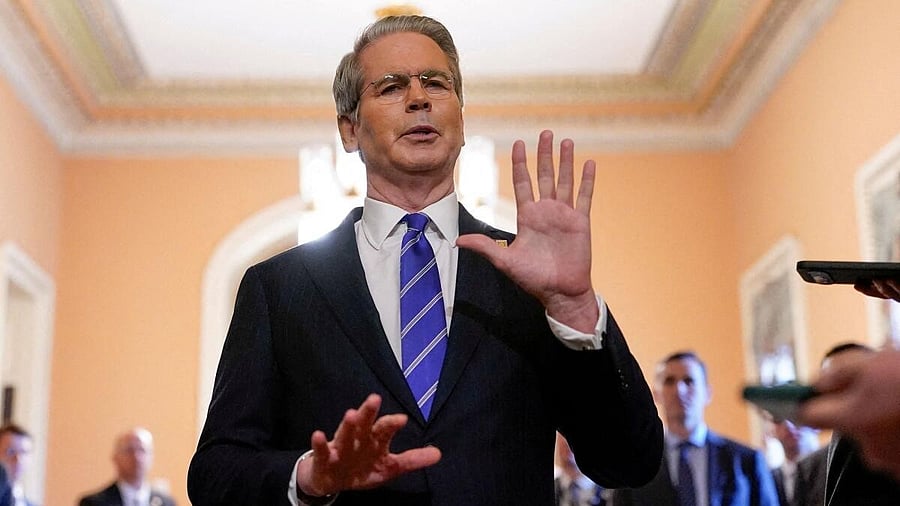
US Treasury Secretary Scott Bessent
Credit: Reuters Photo
The US has termed the Europeans as "very disappointing" amid European Union's free trade agreement with India, adding that they were unwilling to join the US on imposing tariffs on New Delhi for its purchase of Russian oil.
"Again, they should do what’s best for themselves, but I will tell you I find the Europeans very disappointing because the Europeans are on the front line of the Ukraine-Russia war," US Treasury Secretary Scott Bessent said in an interview with CNBC's 'Squawk on thUS-e Street' Wednesday.
The response came to a question on the “massive” trade deal between India and Europe and how it affects the US, given that the countries are moving ahead with free trade without Washington.
"...India started buying sanctioned Russian oil, and guess who was buying the refined products? The Europeans. So, the Europeans have been funding the war against themselves and like something that you couldn’t have made up."
"The US sanctioned or put a 25 per cent tariff on India for buying the Russian oil. The Europeans were unwilling to join us, and it turns out that they wanted to do this trade deal. So, every time you hear a European talk about the importance of the Ukrainian people, remember that they put trade ahead of the Ukrainian people. Trade -- European trade, more important than ending the war in Ukraine,” Bessent said.
On US requiring energy, Bessent said, “At a price, they want cheap energy, but we could have cheaper energy too if we were willing to buy sanctioned Russian oil.”
The Trump administration has been critical of the trade deal between India and the EU.
On Tuesday, when the deal was formally announced, US Trade Representative Jamieson Greer said India came out on “top” in the trade deal.
"I've looked at some of the details of the deal so far. I think India comes out on top on this, frankly. They get more market access into Europe,” Greer had said in an interview to Fox Business.
"It sounds like they (India) have some additional immigration rights. I don't know for sure, but President (Ursula) von der Leyen of the EU has talked about mobility for Indian workers into Europe," Greer said.
"So I think on net, India is going to have a heyday with this. They have low-cost labour, and it looks like the EU is doubling down on globalisation when we're trying to fix some of the problems of globalisation here in the US,” Greer had said.
Further, Greer said that the EU is dependent on India, adding that Europe was trying to find markets to dump their products in due to their overproduction.
India and the EU sealed the landmark free trade agreement, touted as the "mother of all deals", to create a market of two billion people with Prime Minister Narendra Modi and the top EU leadership unveiling a transformative five-year agenda to largely leverage trade and defence in protecting the rules-based world order.
The two sides also inked two crucial pacts -- one on security and defence collaboration and another on mobility of Indian talents to Europe -- after Prime Minister Modi hosted von der Leyen and Costa for summit talks amid frosty ties with the US.
The FTA will encompass nearly a quarter of global GDG, while reducing tariffs on 99 per cent Indian exports to the EU and cut duties on over 97 per cent of the EU's exports to India.
Indian sectors such as textiles, apparel, leather goods, handicrafts, footwear and marine products are set to gain from the FTA, while Europe is set to benefit in areas of wine, automobiles, chemicals and pharmaceuticals, among others.
(With PTI Inputs)