
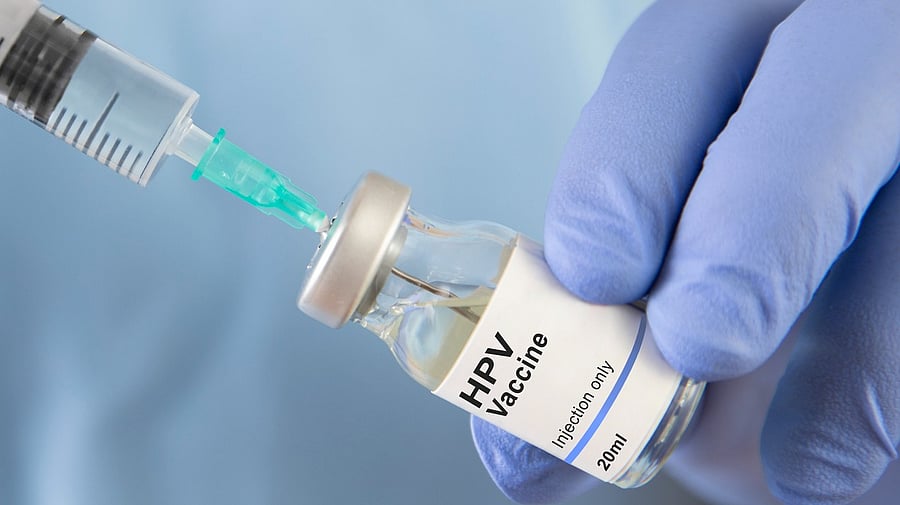
Representative image of HPV Vaccine.
Credit: iStock Photo
New Delhi: With the Centre deciding to introduce HPV vaccine in the national immunisation programme, the Indian Council of Medical Research has begun clinical trials to check the efficacy of a single-dose vaccine as against the standard three-dose regimen.
The Department of Health Research has informed a panel of lawmakers that trials are ongoing at three Indian Council of Medical Research institutes and volunteers would be followed for two years to see whether a single shot vaccine remains effective to protect teen age girls against cervical cancer, the second most common cancer of females in India.
The trial is happening at the National Institute of Translational Virology & AIDS Research, Pune; National Institute of Research in Bacterial Infections, Kolkata and National Institute of Cancer Prevention and Research, Noida.
It will be a two-arm study where participants in one arm will be vaccinated with indigenous Cervavac of Serum Institute and the other arm would receive one dose of Merck-Gardasil, approved as one dose vaccine by the World Health Organisation.
“The trial participant enrolment will be completed within February, 2025. Thereafter, all the participants will be followed up for assessing the levels of HPV antibodies generated after a single dose of indigenous HPV vaccine and their persistence till two years after vaccination,” the Parliamentary Standing Committee on Health notes in its report sharing the department’s response. The report was tabled in both Houses earlier this week.
The lawmakers asked the Department of Health Research to ensure completion of the trials in time to provide “a major fillip to HPV immunisation in India.”
Currently there are only multiple dose vaccines that although provide protection, have practical inconveniences, like keeping track of the dosage schedule.
"A single dose vaccine would considerably increase successful vaccination percentage as the vaccination schedule can be completed with one shot. This, in turn, will have a commensurate impact on the reduction of incidence of cervical cancer, which is a leading cause of cancer among women,” the panel said in its report.
Union Finance Minister Nirmala Sitharaman in her 2024 interim budget had stated, “The government will encourage vaccination for girls in the age group of 9-14 years for the prevention of cervical cancer.”
While the Union Health Ministry subsequently didn’t disclose any roll out plan, a top official in January said the campaign would be rolled out within “a few months.”
Since 2006, HPV shots have been licensed for cervical cancer prevention, initially as a three-dose regimen, and later as a two-dose regimen for girls aged younger than 15 years.
Based on evidence suggesting that one dose of HPV vaccine is as effective in preventing HPV infection and cervical precancerous lesions as a multi-dose regimen, the WHO in 2022 endorsed a single-dose HPV vaccination schedule in females aged 9–20 years.
Scientists from the International Agency for Research on Cancer have recently shown that shifting to a single-dose strategy in India would save approximately $ 435 million over a 10 years period.