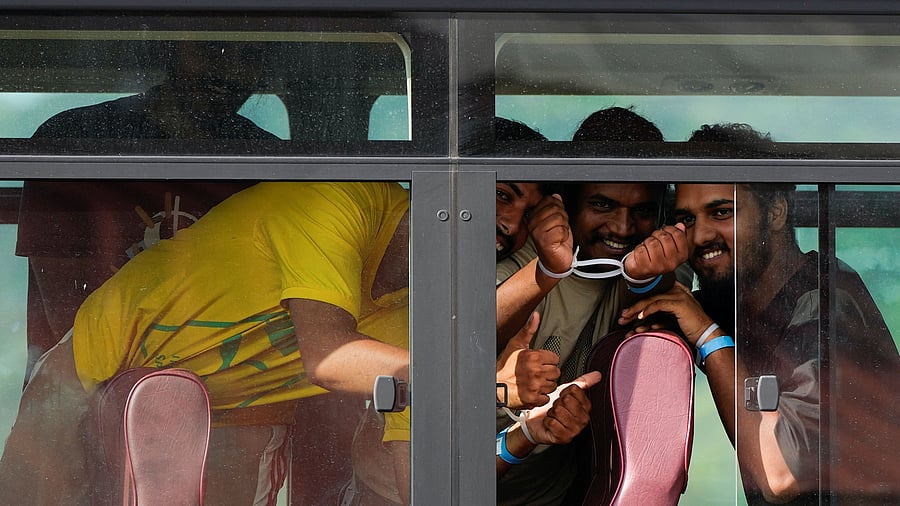
Handcuffed Indian migrants pose for a photo while being transported in a bus, before boarding a deportation flight bound for New Delhi, India, at Panama Pacifico Airport
Credit: Reuters photo
Mehsana/Gandhinagar: Twenty-seven-year-old Samarth Patel has never set foot outside the country, yet he can name several cities in the United States.
Sitting at a dhaba along the highway connecting Mansa town in Gandhinagar district to Mehsana, he said, “Most of my family members are settled in St Louis, Missouri — some run liquor stores, some work as salespersons. I wish to join them but haven’t applied for a visa yet. The rules are strict now. A rejection would mean the end of the road.”
Samarth, who has discontinued his Bachelor of Commerce studies after the second year, said that the deportation of Gujaratis from the US earlier this year had spread fear. He added that one of his distant relatives was among those who were sent back.
“He is in serious trouble, with debts mounting from the money he spent to enter the US illegally and is also facing social stigma. He had gone there with the help of local agents who have connections in America and must have spent between Rs 1 crore and Rs 2 crore. He seems to be stuck now,” Samarth said.
When asked if he would take that route to reach Missouri like his relative, he said, “Never ever.”
The deportation of Indians including Gujaratis from the US earlier this year has changed the migration calculus for aspirants like Samarth. Once drawn to the “dollar dream” of the United States, locals are now increasingly eyeing European nations such as Germany, Portugal and Spain, where relatives have already settled or where there is a perceived demand for skilled and unskilled workers. Human-trafficking cases and the risk of falling into debt or danger abroad have made the journey more clandestine, even as aspirations remain high in north Gujarat’s migrant-heavy districts.
Illegal migration often occurs because there are not enough opportunities, and most do not have the skills needed to secure a legal work visa.
Punjab and Haryana are also among those states with significant reports of illegal immigration but what sets Gujarat apart is the close-knit connection between the region and those who receive these ‘illegal or undocumented aliens’ as they are referred to in the US.
In Gujarat, migration, including illegal, is reported to be high among the Patidar community, which has a sizeable number of diaspora in the US. Over the decades, Patidar-dominated villages migrated en masse, and many of these individuals or groups are reported to be helping the newcomers by offering support. "All you have to do is to reach there and the community stands as a rock solid support", is a common reference point among the aspirants.
Earlier, in January and February 2025, visuals of Indians being deported on US military planes with their hands tied sparked widespread controversy. The impact continues to be felt on the ground in the Gandhinagar and Mehsana districts of north Gujarat, from where a majority of the Gujarat-origin deportees hailed.
In Manekpur Dabhla village, a group of residents told DH that “no one wants to use the dunki route now”. The dunki route refers to a networked illegal migration pathway to the US and other countries through multiple transit nations.
These are also dangerous routes. In 2023, a family of four from the village drowned in the St Lawrence river along the US–Canada border while attempting to reach the US illegally.
In response to a question in the Rajya Sabha in March, the Ministry of External Affairs stated that between January and February 2025, a
total of 388 Indian nationals were deported to India.
Of these, 333 were deported directly from the US after verification, while 55 were deported via Panama. The highest numbers were from Punjab (126), Haryana (110), and Gujarat (74).
The ministry noted that “from 2009 to 2024, a total of 15,564 Indian nationals were deported by the US through chartered and commercial flights.” The ministry also stated that the US
has been carrying out such operations for a long time.
Although there is no official data, local accounts suggest that apprehensions at the US border have reduced. US Customs and Border Protection (CBP) data released in October revealed that 34,146 Indian nationals were detained trying to enter the country illegally between October 2024 and September 2025, compared to 90,415 in the previous fiscal year.
Detained migrants are either deported immediately or held in immigration detention centres until the deportation process is completed.
On December 4, the Department of Homeland Security stated, “Preliminary data shows both US Border Patrol apprehensions and total CBP encounters declined from October to November, making this the lowest number of encounters for the start of a fiscal year in history.”
Shift in focus
DH travelled across Gandhinagar and Mehsana, where a large number of locals have settled in the US. Billboards, posters and banners put up by travel agents to attract aspirants continue to line roads.
“I think the Donald Trump administration’s crackdown on illegal immigration has impacted a lot,” said Manish Sharma, who runs Akshar Travels, in Ahmedabad.
Dipak Patel from Akhaj village runs a chain of liquor stores in Missouri. He moved to the US in 2009 to join his elder brother. “I am an overseas citizen of India. A total of 56 family members have settled there,” he said, declining to name the liquor chain or give any other specific information.
He spoke about stricter US immigration policies, including tighter H-1B visa rules and enforcement against illegal immigrants.
Nearly a year after visa restrictions were imposed in the US, many aspirants are said to have shifted their focus to European countries. In 2025, at least three Gujarat families attempting illegal settlement in the UK and Portugal were trapped by human traffickers and forced to pay hefty ransoms for release.
“There is a general perception among people that it is easy to settle in European countries such as Germany, Portugal and Spain, especially for those with relatives already there,” a Patidar community leader, requesting anonymity, told DH. “Most of the illegal cases we come across involve people whose relatives are already settled there. They have a support system, which is why they attempt it,” he added.
Kidnap nightmare
On November 29, Kismat Chavda, his wife Heena, and their three-year-old daughter flew from Ahmedabad to Dubai, aiming for Portugal. The family had long dreamed of settling in the European country, inspired by Kismat’s brother who had settled there, working as a farm labourer.
In less than three days, the family’s journey turned into a nightmare. After two days in Dubai, human traffickers, posing as travel agents, took them to Benghazi in Libya. Back in Badalpura village in Mehsana district, Kismat’s uncle began receiving WhatsApp calls claiming that his nephew and family had been kidnapped, along with graphic videos of Kismat pleading for money, and demands for a Rs 2 crore ransom.
“After negotiations, they settled for Rs 85 lakh. We had to pay; government help would have taken too long,” said Kismat’s cousin Mahipat. With previous expenses of Rs 30 lakh, Kismat is now over Rs 1 crore in debt.
When DH visited his home in Badalpura village in Gandhinagar district on December 28, Kismat had left for Ahmedabad to visit a temple where his sister had made a vow for his safe return.
Kismat lives in a one-bedroom house, with separate spaces for a kitchen, washroom and backyard. Inside, steel utensils are neatly arranged, and family photos adorn the wall.
A school dropout, Kismat earned Rs 20,000-Rs 25,000 a month in a factory. “The family doesn’t have any land or any other source of income. His brother earns in dollars and so he thought of taking a chance,” said Kismat’s uncle Kiran Chavda.
Similarly, in October 2025, four members of the Chaudhary family from Bapupura in Mansa were kidnapped in Tehran on their way to Australia. They were taken to Bangkok, Dubai and Tehran, where they were held captive.
In June 2023, another couple was kidnapped in similar fashion in Tehran. They were on their way to enter the US illegally. While they were released after government intervention, and allegedly after paying Rs 15 lakh to the kidnappers, a police case in Ahmedabad against the agent revealed the couple had promised to pay Rs 1.5 crore once they reached the US.
“In light of the deportation of illegal immigrants from the US and the various cases we have filed against the agents here, we can say that such incidents have decreased significantly. While we can’t claim that these cases have stopped completely, there is now a clear deterrent,” Virendra Singh Yadav, Inspector General of Police, Gandhinagar range police, told DH.
Why migration persists
North Gujarat, which has one of the highest numbers of migrants settled in the US, is largely dominated by the Patidar community, a highly influential electorate.
The region was the epicentre of the 2015–16 Patidar agitation for reservation, fueled by an agrarian crisis. Small, fragmented landholdings make agriculture unsustainable. While government jobs are still preferred, private industries cannot meet soaring employment demand.
Every year, non-resident Indians from the US fund temples, schools and community facilities, leaving plaques acknowledging donations in crores. For people like Samarth Patel, a monthly salary of Rs 25,000–30,000 seems inadequate, especially when stories of relatives sending money home in dollars abound. These factors continue to fuel the aspiration to migrate, despite the risks involved.