
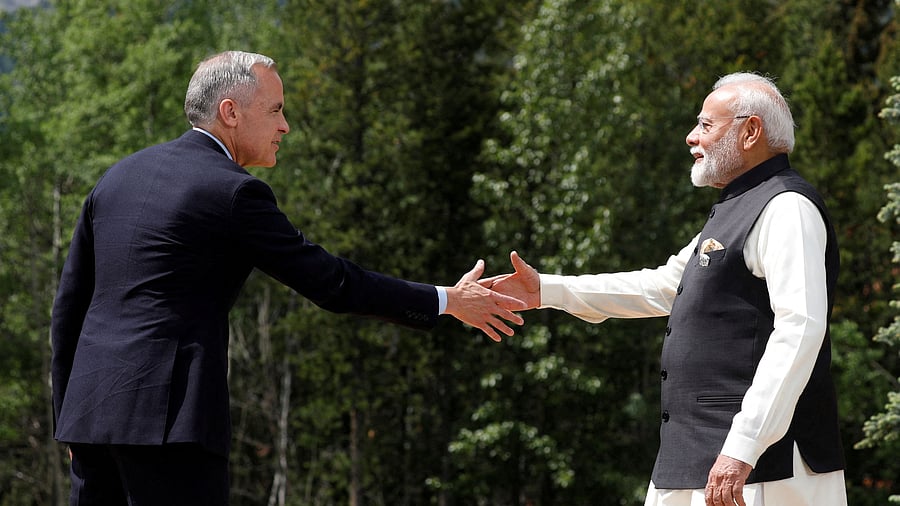
Canadian Prime Minister Mark Carney and India's Prime Minister Narendra Modi shake hands before posing for a photo during the G7 Leaders' Summit in Kananaskis, in Alberta, Canada, June 17, 2025.
Credit: Reuters Photo
New Delhi: Notwithstanding the protests by the Khalistani Sikh extremists near the G7 summit venue at Kananaskis, Alberta, in Canada, New Delhi and Ottawa are set for a reset in bilateral relations, with Prime Minister Narendra Modi having his first meeting with Mark Carney, his new counterpart in the North American nation.
The Modi-Carney meeting on the sidelines of the G7 summit is likely to lead to the revival of bilateral relations that hit a new low in 2023 and 2024, in the wake of Ottawa’s allegation about New Delhi’s role in the killing of Hardeep Singh Nijjar, a Khalistani Sikh extremist who had fled to Canada to avoid trial in India for terrorism. Four citizens of India living in Canada were charged with murdering him. The two prime ministers are likely to explore ways to ensure that the judicial process in Canada over the killing of Nijjar does not hurt bilateral relations with India.
The prime minister arrived in Calgary, Canada, early on Tuesday, after completing his visit to Cyprus. He will attend an outreach event being held on the sidelines of the G7 summit. This is going to be his first plurilateral engagement after the April 22 terrorist attacks in Jammu and Kashmir and India’s launch of ‘Operation Sindoor’ early on May 7 to destroy terrorist camps in Pakistan as well as in areas under the illegal occupation of Pakistan, followed by four days of military offensives and counter-offensives between the two South Asian nations.
A source in New Delhi said that the prime minister, in his address to the G7 leaders, would stress the need to combat terrorism in all its forms and manifestations.
Modi would also convey to the G7 leaders the concerns of India and the other ‘Global South’ nations on the Russia-Ukraine conflict and the latest flare-up between Israel and Iran.
Apart from Carney, he will have bilateral meetings with other leaders, including President Volodymyr Zelenskyy of Ukraine.
A proposed meeting between Modi and Donald Trump has been cancelled as the United States president left the summit venue to return to Washington, DC, a day earlier than scheduled, in view of the Israel-Iran military flare-up.
Carney drew flak from the Khalistani Sikh extremists and their sympathisers after he called Modi on 6 June and invited him to attend the G7 summit, even as the law enforcement agencies were still investigating the role of India in the killing of Nijjar, a fugitive terrorist, in Canada two years back. The members of Sikhs for Justice have been staging protests near the G7 summit venue over the past few days. The Khalistani Sikh extremists also launched similar protests in other cities in Canada.
Nijjar led the terrorist organisation, Khalistan Tiger Force, in India before fleeing to Canada. He was shot dead at the parking lot of a gurdwara in Surrey in the British Columbia province of the North American country on June 18, 2023. Carney’s predecessor, Justin Trudeau, in September 2023, alleged that agents of the Government of India had been involved in the killing of Nijjar. New Delhi refuted the allegation, which, however, brought India-Canada relations to a new low over the past couple of years.
Modi, according to the sources, may urge Carney to act on the long-pending requests from New Delhi for Ottawa to extradite the Khalistani Sikh terrorists, including Gurjeet Singh, Gurjinder Singh, Gurpreet Singh, Lakhbir Singh Landa, and Arshdeep Singh Gill, and to ensure that the extremists can no longer run a secessionist campaign against India from Canada.
Ottawa, in October 2024, had gone on to accuse India’s High Commissioner to Canada, Sanjay Kumar Verma, and his five colleagues of having a role in the June 18, 2023 killing.
The Royal Canadian Mounted Police had, on October 14, 2024, publicly accused the agents of the Government of India of orchestrating criminal activities in Canada.
New Delhi had withdrawn Verma and its other diplomats in the North American country after denying Ottawa’s request to waive their diplomatic immunity and to make them available for questioning by the police investigators in connection with the murder of Nijjar. India had also expelled six diplomats of Canada.