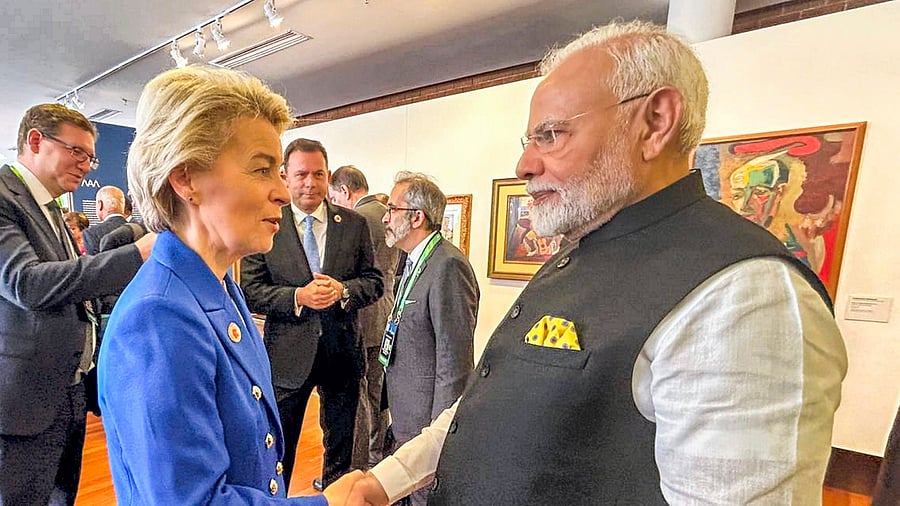
Narendra Modi and European union President Ursula von der Leyen
Credit: PTI Photo
New Delhi: India and the European Union on Tuesday announced the conclusion of negotiations on the free trade agreement (FTA), which is likely to be implemented by the end of this year paving way for elimination or reduction of tariffs on the majority of traded goods.
As part of the deal, the 27-nation bloc EU has agreed to lower or eliminate tariffs on over 99% of goods imported from India. On the other hand, India has agreed to cut tariffs on 97% of imports from the EU nations.
While the negotiations for the deal, which was first launched in 2007, has been concluded, it may take several months to get the deal signed and implemented.
Commerce and Industry Minister Piyush Goyal said the pact is likely to be implemented by the end of 2026. “It will be taken up for a legal scrubbing on a fast track basis. We do hope that we should be able to celebrate the entry into force of this agreement within calendar 2026 itself,” Goyal told reporters.
Prime Minister Narendra Modi, European Commission President Ursula von der Leyen and European Council President Antonio Costa jointly announced the conclusion of the deal at the 16th India–EU Summit.
“Today, India has concluded the largest free trade agreement in its history. It is a happy coincidence that on the 27th day of the month, India is entering into this FTA with the 27 member states of the European Union,” Modi said in a joint statement after the summit.
The deal comes amid volatile trade policies and new tariff threats by the US on both India and the European countries. Analysts see the India-EU free trade deal as their strategic hedge against US President Donald Trump’s volatile trade policies.
European Commission President von der Leyen, who has hailed the EU-India FTA as "mother of all deals" sent a clear message to the Trump administration.
"The EU and India make history today, deepening the partnership between the world's biggest democracies. We have created a free trade zone of 2 billion people, with both sides set to gain economically," she said.
"We have sent a signal to the world that rules-based cooperation still delivers great outcomes. And, best of all, this is only the start - we will build on this success, and grow our relationship to be even stronger," von der Leyen added.
This is the fourth free trade deal India has sealed since the US announced imposition of steep 50% tariffs on imports of the majority of Indian goods. India-UK Comprehensive Economic and Trade Agreement was signed in July 2025 followed by similar deals with Oman and New Zealand in December.
With the EU deal, Goyal claimed that India will have preferential trade agreements with 37 developed nations. This is the eighth free trade deal concluded under Prime Minister Modi government.
The minister claimed that labour-intensive sectors such as textiles, apparel, leather, footwear, marine products, automobiles and gems and jewellery would be among the big beneficiaries of the India-EU free trade deal. Once implemented, 93% of Indian shipments will enjoy duty-free access to the EU member countries.
Not just exporters, the deal also brings good news for the Indian consumers. The items like luxury cars, wine, beer, chocolates, breads and olive oil imported from the EU countries will become cheaper.
As per a statement released by the European Commission, India has agreed to cut tariffs on wines from 150% to 75% at entry into force and eventually to 20% in five years. Tariffs on olive oil will go down from 45% to 0%, while processed agricultural products such as bread and confectionery will see tariffs of up to 50% eliminated.
India has also agreed to cut tariffs on cars gradually from 110% to 10%, while on auto parts it will be reduced to zero in five to ten years. Tariffs ranging up to 44% on machinery, 22% on chemicals and 11% on pharmaceuticals will also be mostly eliminated.
The two sides have also agreed to ease non-tariff barriers through strengthened regulatory cooperation, greater transparency, and streamlined customs, Sanitary and Phytosanitary (SPS) procedures, and technical barriers to trade disciplines.
However, there is no substantial relief on the carbon border adjustment mechanism (CBAM) regulation of the EU.
“Through CBAM provisions, commitments have been secured including a forward-looking most-favoured nation assurance extending flexibilities if any granted to third countries under the regulation,” as per a statement released by the Ministry of Commerce and Industry.