
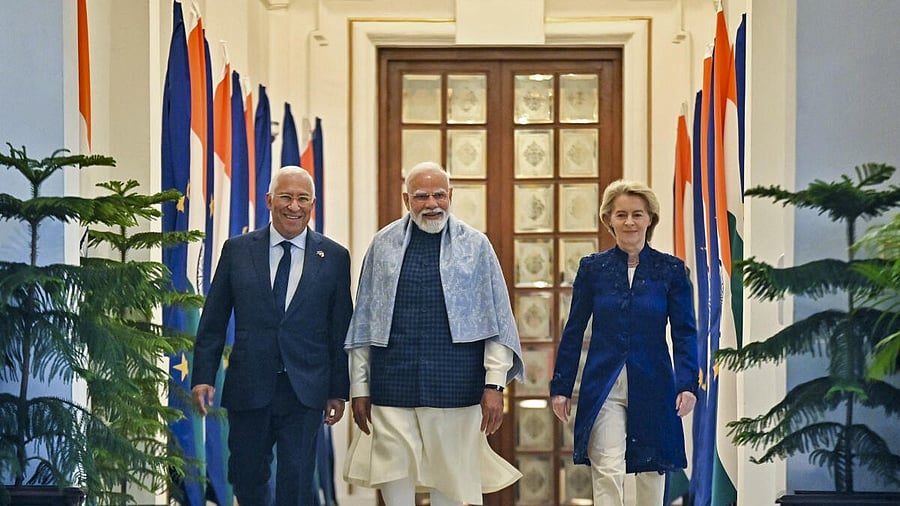
Prime Minister Narendra Modi flanked by European Council President Antonio Costa (L) and European Commission President Ursula von der Leyen.
Credit: PTI Photo
India and the European Union (EU) announced the historic free trade agreement (FTA) on Tuesday.
The deal is expected to boost the economies of India as well as the group of 27 European nations.
The EU said that this is the most ambitious trade opening that India has ever granted to a partner, adding that India will grant the European counties with tariff reductions that none of its other trading partners have received.
The deal reduced tariffs in value of 96.6 per cent of EU goods exports to India. It is expected to double EU goods' exports to India by 2032 by eliminating or reducing tariffs.
The tariff reductions will save around 4 billion euros a year in duties on European products, the EU said in a press release.
Here's what gets cheaper in India
Non-agricultural products
Motor vehicles: European cars will see one of the biggest cuts in tariffs in the Indian markets. The rate will come down drastically from up to 110 per cent to 10 per cent over the years, with a quota of 250,000 units.
Pharmaceuticals: Tariffs cut to 0 per cent from 11 per cent on medicines.
Machinery and electric equipment: The tariff for EU imported machines and electronic goods will come down from up to 44 per cent to nil on most projects.
Aircraft and spacecraft: Tariffs on products associated with aircraft and spacecraft will also be 0 per cent from the current 11 per cent on most goods.
Optical, surgical and medical equipment: Tariffs will reduce from up to 27.5 per cent to 0 per cent on 90 per cent of the products.
Plastics: Tariffs set at 0 per cent for almost all products from the existing 16.5 per cent.
Pearls, precious stones and metal jewellery will also attract lower tariffs, from up to 22.5 per cent to 0 per cent for 20 per cent of the products and tariff reduction for another 36 per cent of the products.
Chemicals: These goods imported from the EU will attract 0 per cent tariff for almost all products, down from up to 22 per cent.
Iron and steel: Most of these products will also have 0 per cent tariffs.
Agricultural products
Wine: Tariffs on EU wine will come down from 150 per cent to premium range); 30 per cent (medium range).
Spirits: Customs duty will go down from up to 150 per cent to 40 per cent.
Beer: Duties on EU imported beer will reduce from 110 per cent to 50 per cent.
Olive oil, margarine and other vegetable oils: These products have been made tariff free, while it was up to 45 per cent earlier.
Kiwis and pears: Tariffs will come down from 33 per cent to 10 per cent - in quota.
Fruit juices and non-alcoholic beer: Tariffs on these products will be slashed to 0 per cent from 55 per cent.
Processed food (breads, pastries, biscuits, pasta, chocolate, pet food): such products have also been made tariff free from the current 55 per cent.
Sheep meat: EU-imported sheep meet will attract 0 per cent tariff. It currently stands at 33 per cent.
Sausages and other meat preparations: Tariffs on such products will be slashed to 50 per cent from up to 110 per cent.