
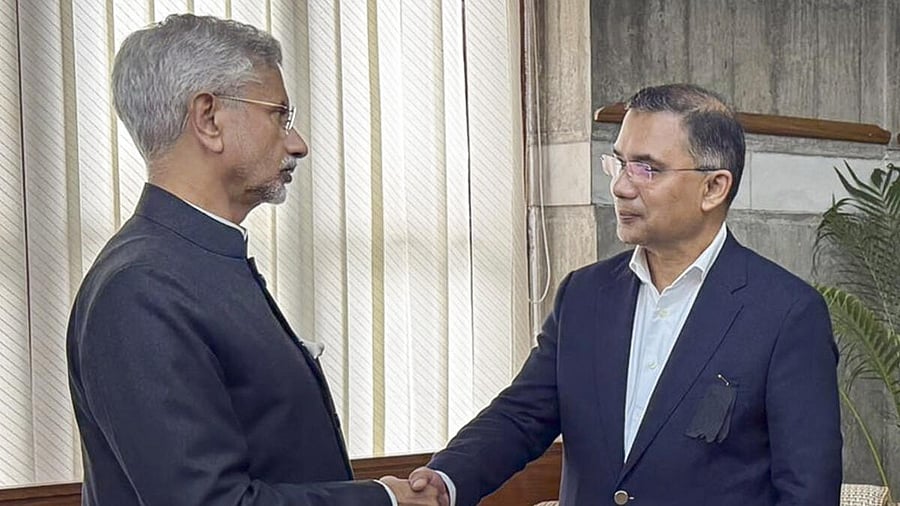
In this image posted on Dec. 31, 2025, External Affairs Minister S Jaishankar, left, with Acting Chairman of BNP and son of former PM of Bangladesh Begum Khaleda Zia Tarique Rahman during his visit for the funeral of former prime minister Khaleda Zia, in Bangladesh.
Credit: Reuters Photo
New Delhi: External Affairs Minister S Jaishankar on Wednesday flew to Dhaka and not only attended the funeral of Bangladesh Nationalist Party’s supremo, Begum Khaleda Zia, but also met her son, Tarique Rahman, and handed over to him a personal condolence letter from Prime Minister Narendra Modi.
Jaishankar, however, did not meet Muhammad Yunus, who had taken over as the head of the interim government in Dhaka after a mass agitation across Bangladesh in July-August 2024 had led to the fall of the Awami League government headed by Sheikh Hasina. The relations between New Delhi and Yunus’s regime in Dhaka worsened over the past few weeks. Yunus, however, posted on social media a picture of Jaishankar with Pakistan’s National Assembly Speaker Ayaz Sadiq, who represented Islamabad at the funeral of Khaleda Zia in Dhaka. A source in New Delhi clarified that Jaishankar had just exchanged pleasantries with Sadiq.
Khaleda Zia was the first female prime minister of Bangladesh and led the Bangladesh Nationalist Party, founded by her husband Ziaur Rahman in 1978, till her imprisonment in graft cases in 2018. Tarique Rahman, who has been the de facto leader of the BNP for the past seven years, recently returned to Dhaka after a 17-year exile in London and formally took over as the chairman of the party after his 80-year-old mother passed away on Tuesday.
“Conveyed deepest condolences on behalf of the Government and people of India,” Jaishankar wrote on X after meeting Tarique. “Expressed confidence that Begum Khaleda Zia’s vision and values will guide the development of our partnership.”
Tarique is likely to lead the BNP in the elections to the Jatiya Sangsad (parliament) of Bangladesh scheduled to be held in February 2026. With Sheikh Hasina’s Awami League barred from participating in the elections, the BNP has an edge over its former ally, Jamaat-e-Islami Bangladesh, and other parties. Tarique may emerge as the frontrunner for the office of the prime minister in Dhaka after the elections to the Jatiya Sangsad.
Dhaka’s relations with New Delhi had come under stress during Khaleda Zia’s three terms as prime minister of Bangladesh between 1991 and 2008. Her government had allowed the militant organisation operating in the northeastern states of India to set up camps in Bangladesh. She had turned down New Delhi’s request to Dhaka for connectivity through Bangladesh between India’s landlocked northeastern states and its mainland. Her party, BNP, even recently accused New Delhi of allowing the deposed prime minister of Bangladesh, Sheikh Hasina, and her Awami League to stay in India and hatch a conspiracy to destabilise her country. With New Delhi’s relations with Yunus’s regime in Dhaka under stress, India has been reaching out to the first family of the BNP in Bangladesh over the past few months. New Delhi, according to the sources, even had informal contacts with Tarique in London, as well as other leaders of the party in Dhaka.
As Khaleda’s health deteriorated and she had been put on a ventilator in a hospital in Dhaka since November 23, New Delhi had on December 1 offered support for her medical care, notwithstanding her party’s campaign against India. “As the first woman prime minister of Bangladesh, her important contributions towards the development of Bangladesh, as well as India-Bangladesh relations, will always be remembered,” Modi posted on X after her demise early on Tuesday. “I recall my warm meeting with her in Dhaka in 2015. We hope that her vision and legacy will continue to guide our partnership.”
Yunus’s bid to dismiss India’s concerns over atrocities on the minority Hindus in Bangladesh, his moves to steer Bangladesh closer to Pakistan and China, notwithstanding the security concerns of India, and New Delhi’s tacit rejection of Dhaka’s plea for the extradition of Sheikh Hasina and other Awami League leaders, have strained the bilateral relations since August 2024. Dhaka’s bid to link India and the Awami League leaders currently in India with the murder of right-wing student leader Sharif Osman Hadi on December 12, India’s public expression of concern over the recent brutal killing of a man of the minority community in Bangladesh, and protests near diplomatic and consular missions of each other in India and Bangladesh, worsened the relations between the two neighbours.