
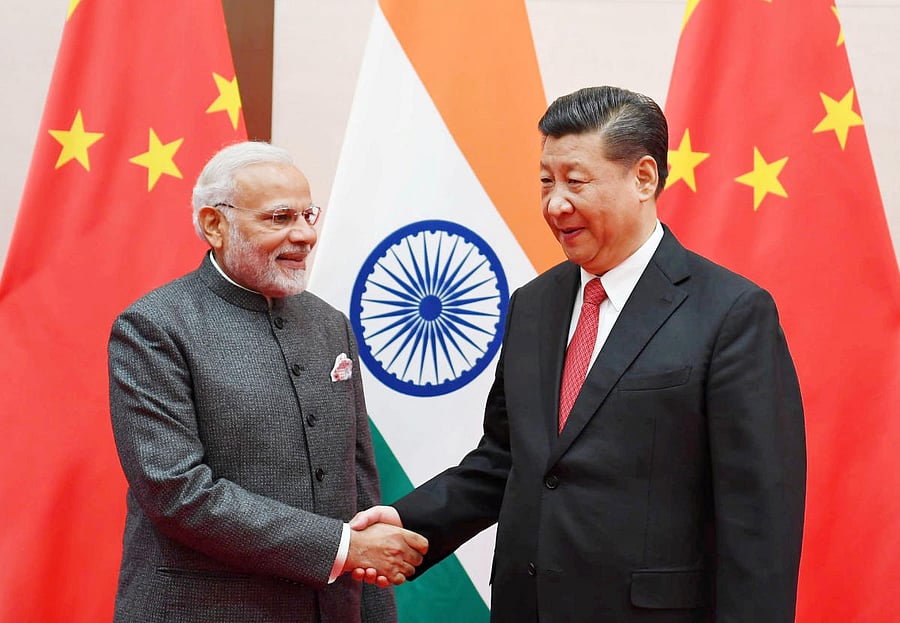
India will send two trade delegations to China soon, with both sides focusing on expanding commerce since Prime Minister Narendra Modi had an “informal summit” with Chinese President Xi Jinping last April.
A trade delegation from India is set to visit China on Wednesday and Thursday to explore opportunities for export of soya, sugar and non-basmati rice to the communist country. The Pharmaceutical Export Promotion Council of India will send another trade delegation to attend a conference in Shanghai on August 21 and 22 and explore ways to augment export of anti-cancer and antibiotic drugs to China, officials told the DH in New Delhi.
New Delhi and Beijing have focused on augmenting bilateral trade ever since Modi and Xi had an informal summit at Wuhan in central China on April 27 and 28 and agreed on a roadmap to mend ties, which hit a new low last year over the 72-day-long face-off between Indian Army and Chinese People’s Liberation Army at Doklam Plateau in western Bhutan.
India's trade deficit with China expanded $ 38.72 billion in 2012-13 to $ 51.11 billion in 2016-17 and further to $ 62.94 billion in 2017-18. India's exports to China in 2017-18 amounted to $ 13.3 billion, while its imports from the neighbouring country were worth $ 76.2 billion. Trade remained high on agenda even when Modi and Xi followed up the informal summit at Wuhan with meetings at Qingdao on the east coast of China on June 9 as well as at Johannesburg in South Africa on July 26. New Delhi has been underlining in all its interactions with Beijing that the burgeoning trade imbalance is unsustainable and not conducive for long-term growth in bilateral commerce. China has been promising India that it would take measures to narrow the trade imbalance.
China’s recent trade war with the United States too of late prompted it to consider opening up its market for some products from India.
Modi-Xi meeting on the sideline of the Shanghai Cooperation Organization’s Summit in Qingdao on June was followed by the signing of a bilateral Memorandum of Understanding to amend the protocol on the phytosanitary requirement for export of rice from India to China. The MoU opened up a door for India to export non-basmati rice to China.
China earlier imported only basmati rice from India. But, after the MoU was inked, it cleared 14 of the 19 registered rice-exporting companies of India to export non-basmati rice to China.
Beijing eliminated tariffs on the import of soya from India and a few other countries from July 1. The move came after Beijing imposed an addition 25% tariff on import of soya and other items from the US, in response to President Donald Trump’s “protectionist measures” targeting exports from China to America. China has of late also signalled its willingness to import raw sugar from India, and the first shipment is likely in October.
India is also exploring possibilities for importing urea from China and it is likely to be on the agenda during the visit of the trade delegation this week, senior officials said.
Beijing has of late eliminated tariffs on the import of 28 anti-cancer and antibiotic drugs – a move, which is likely to open up an opportunity for the pharmaceutical companies of India to get greater access to the market in China. The Chinese Government also brought down value-added tax levied on 103 of the 138 anti-cancer drugs. New Delhi is now persuading Beijing to simplify and speed up the currently complex and lengthy process of trials and approvals for import of pharmaceutical products from India to China. The issue will be discussed further during the visit of the delegation of pharmaceutical exporters of India to China on August 21 and 22.
Uday Bhaskar, Director General of Pharmaceuticals Export Promotion Council of India, recently noted in a circular that the Chinese Government were also adopting measures to lower costs, such as price negotiations with manufacturers, greater use of centralized government procurement and inclusion of a wider range of antineoplastic drugs in the national healthcare insurance program. These initiatives are opening the market opportunities for India pharmaceuticals companies and in fact, the approval process is also being eased for new medicines from overseas, especially for those treating rare diseases and life-threatening ailments, he noted.
“With the acceleration of inspection and approval procedures of drugs developed overseas, by the Chinese side, we see a huge scope for India Pharmaceuticals to export lifesaving drugs, antibiotics and anti-infective products to China,” Bhaskar wrote in a circular to exporters on July 12.