
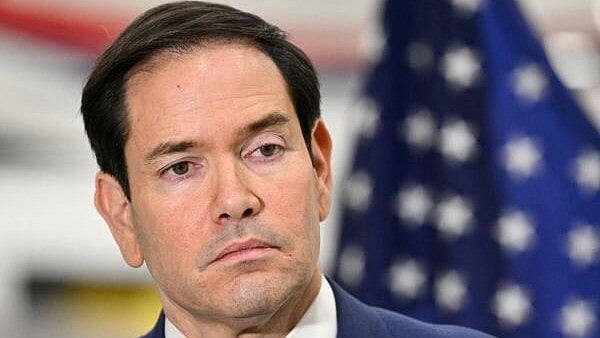
US Secretary of State Marco Rubio.
Credit: Reuters Photo
New Delhi: The approach of Prime Minister Narendra Modi’s government after the November 10 blast near Red Fort in Delhi was measured, said United States Secretary of State Marco Rubio, who had repeatedly nudged India, after the April 22 terrorist attack in Jammu and Kashmir, to de-escalate tension with Pakistan.
Rubio, who had a meeting with External Affairs Minister S Jaishankar in Canada on Wednesday, also said that India did not need the US help in investigating the November 10 explosion.
“So, but clearly, I mean, we’re aware of the potential that it has, and so we spoke about that a little bit today – the potential that it has to become something broader,” the US Secretary of State said, referring to his meeting with Jaishankar on the sidelines of a G7 outreach meeting at Niagara in He was replying to a query by a journalist about the possibility of the explosion in Delhi triggering fresh tension between India and Pakistan, which had gone to the brink of a full-fledged war after the carnage at Baisaran Meadow in Pahalgam in J&K on April 22. “But I think we’re going to wait and see what their investigation reveals. We’ve offered to help, but I think they’re very capable in these investigations. They don’t need our help,” Rubio said, adding: “They’re doing a good job, and I thought they were very measured and professional in how they’ve approached it, as they usually are.”
After the armed men from Pakistan and the areas illegally occupied by Pakistan killed 26 people – mostly tourists – in Pahalgam in J&K, India launched ‘Operation Sindoor’ early on May 7, targeting the training camps across its Line of Control (LoC) as well as the undisputed stretch of its border with its western neighbour. Pakistan responded by targeting military facilities and the civilian population in India. The cross-border flare-up came to its end with a ceasefire on May 10.
Though many nations condemned the latest carnage in J&K, most of them refrained from calling out Pakistan for persistently sponsoring terrorism against India.
During the May 7-10 cross-border military offensive and counter-offensive between India and Pakistan, several nations, including the US, urged New Delhi to exercise restraint or work with Islamabad to diffuse tension.
President Donald Trump of the US and his administration re-hyphenated India and Pakistan and, despite New Delhi’s rebuttals, claimed credit for brokering a ceasefire between the two South Asian nations.
A senior US Army commander showered praise on the Pakistan Army for hunting down the ISIS-K terrorists and called it a “phenomenal partner” in counterterrorism. Though New Delhi accused Pakistan Army chief, Field Marshal Asim Munir, of provoking the April 22 attacks with his communal rhetoric against India, Trump hosted him at the White House on June 18 and again on September 26. He even called Munir his “favourite field marshal”.
New Delhi has not yet blamed Pakistan for the November 10 blast near Red Fort in the national capital, as the investigation so far has suggested the role of a homegrown terror module, which had planned a series of explosions.
“But I think the Indians are – need to be commended; they have been very measured and cautious and very professional in how they’re carrying out this investigation. That investigation continues,” Rubio said in Canada, adding: “Clearly, it was a terrorist attack. It was a car loaded with highly explosive materials that detonated and killed a lot of people. But I think they’re doing a very good job of carrying out an investigation, and I think when they have facts, they’ll release those facts.”
New Delhi, however, reaffirmed its unwavering commitment to “a policy of zero tolerance towards terrorism in all its forms and manifestations”. The government ordered the investigating agencies to quickly identify perpetrators, their collaborators, and their sponsors and bring them to justice without delay.