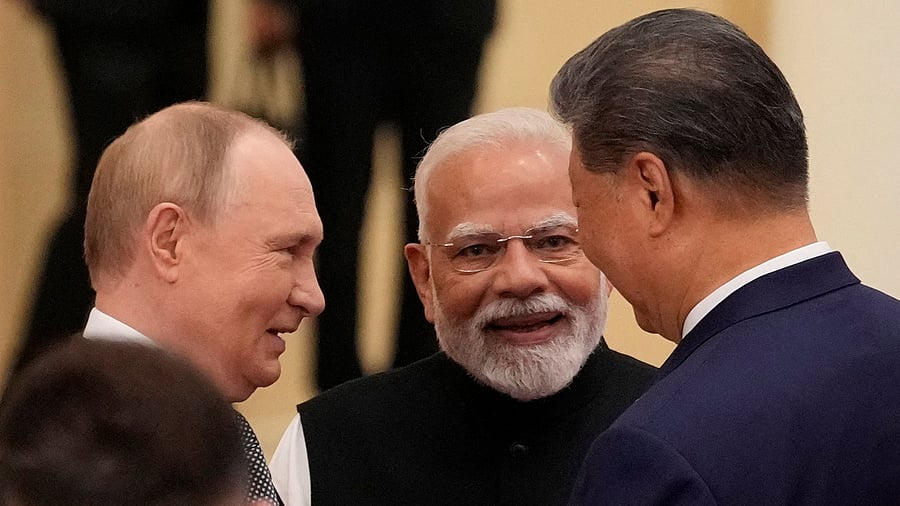
Indian Prime Minister Narendra Modi talks with Russian President Vladimir Putin and Chinese President Xi Jinping ahead of the Shanghai Cooperation Organization (SCO) Summit 2025 at the Meijiang Convention and Exhibition Centre in Tianjin, China, September 1, 2025.
Credit: Reuters photo
New Delhi: For India's diplomacy, 2025 was a giant test in many ways as it had to navigate the geopolitical implications of the worst military conflict in decades with Pakistan, US President Donald Trump's punitive tariffs and increasingly troubled relations with Bangladesh.
As the horrific terror attack in Jammu and Kashmir's Pahalgam in April killing 26 innocent people triggered global outrage, India displayed a steely resolve in combating cross-border terrorism from Pakistan, telling leading global capitals it has a right to respond.
Following the terror strike, India announced a series of punitive measures against Pakistan including suspension of the 65-year-old Indus Water Treaty with Prime Minister Narendra Modi asserting that "water and blood cannot flow together".
Exactly two weeks after the terror attack, India launched 'Operation Sindoor' carrying out airstrikes on nine terror camps in Pakistan and Pakistan-Occupied Kashmir in the early hours of May 7 eliminating at least 100 terrorists.
The strikes triggered a rapid escalation in tensions with Pakistan launching retaliatory strikes though most of them were thwarted by the Indian military.
With rapid escalation in the situation sparked fears of a full-scale war between the two nuclear-armed countries, several world capitals called for restraint and reached out to both New Delhi and Islamabad to stop the fighting.
The hostilities ended with an understanding on halting the military actions on May 10 following talks over the hotline between army officials of the two sides, but the episode brought new headache for India's foreign policy mandarins with Trump announcing the ceasefire first in a social media post.
Over the next few months, the US president repeatedly and publicly claimed that had resolved the military conflict between India and Pakistan and saved millions of lives as it was going in the direction of a full-scale war.
New Delhi stoutly maintained that the cessation of the hostilities was the result of talks between India and Pakistan and the US involvement had nothing to do with it. This riled the Trump administration.
Amid simmering strain in the India-US ties, Trump, in an unprecedented move, hosted a closed-door lunch for Pakistan army chief Field Marshal Asim Munir at the White House on June 18. The Trump-Munir meeting marked a major boost in US-Pakistan ties.
Trump had a second meeting with Munir in the White House on October 1.
As talks for a bilateral trade agreement were dragging on, Trump in August slapped a crushing 50 per cent tariff on Indian goods including an additional 25 percent levies for buying Russian crude oil.
The tariffs added more frost in ties with the relations between the two partners now possibly going through its worst phase in the ties in the last two decades.
Washington's new immigration policy and its decision to increase H1B visa fee to a whopping USD 1,00,000 also appeared to contribute to the slide in India-US ties.
The sharp downturn in the relations surprised many foreign policy experts as Trump's first tenure as the president saw bonhomie between the two leaders.
Another striking development was Pakistan inking a strategic defence pact with Saudi Arabia that came months after India's Operation Sindoor against India.
The pact mentions that "any aggression against either of the two countries shall be considered as an aggression against both".
India's relations with Bangladesh also came under severe strain, largely due to increasing activities of extremist elements which targeted minorities including Hindus.
Bangladesh's increasing engagement with Pakistan and China also contributed to the downturn in the relations. The slide in the relations began after deposed prime minister Sheikh Hasina fled India in August 2024 in the face of a massive anti-government protest that ended her nearly 16-year rule.
However, India's relations with China witnessed significant improvement in 2025 with both sides initiating a series of measures to rebuild the ties that saw major downturn during the over four-year eastern Ladakh border row.
These measures included resumption of Kailash Manasarovar Yatra, direct flights and easing of visa regimes.
In August, Modi and Chinese President Xi Jinping agreed to deepen bilateral ties to combat pressing challenges and work towards a "fair" solution to the festering border issue.
In a meeting in the Chinese city of Tianjin on the margins of the Shanghai Cooperation Summit, Modi and Xi also vowed to expand trade and investment ties to stabilise global commerce.
Days ahead of Modi's trip to China, Chinese Foreign Minister Wang Yi visited New Delhi India that saw both sides unveiling a series of measures for a "stable, cooperative and forward-looking" relationship that included jointly maintaining peace along the frontier, reopening border trade and promoting investment flows.
India's relations with Russia also witnessed a major upswing including in the energy sector notwithstanding mounting Western pressure. In the fag end of the year, Russian President Vladimir Putin visited India during which both sides firmed up a five-year plan to bolster trade partnership in the face of Washington's punitive tariff and sanctions regime.
In July, India and the UK sealed a historic free trade agreement to inject new energy in economic ties as it will provide for slashing tariffs, increase access to each other's markets, enhance trade, and create jobs.
The year also saw India and Canada making efforts to rebuild ties that saw a spell of distrust and suspicion following a diplomatic row two years ago.
The India-Canada relations hit rock bottom after then Prime Minister Justin Trudeau's allegations in 2023 of a potential Indian link to the killing of Hardeep Singh Nijjar. India had dismissed Trudeau's accusation as "absurd".
In the overall foreign policy domain, concerns relating to Indo-Pacific and the way forward found greater salience in New Delhi's diplomatic engagements.
In the year, New Delhi's diplomacy also focused on boosting the country's energy security as it made renewed efforts to expand cooperation with the Gulf region.