
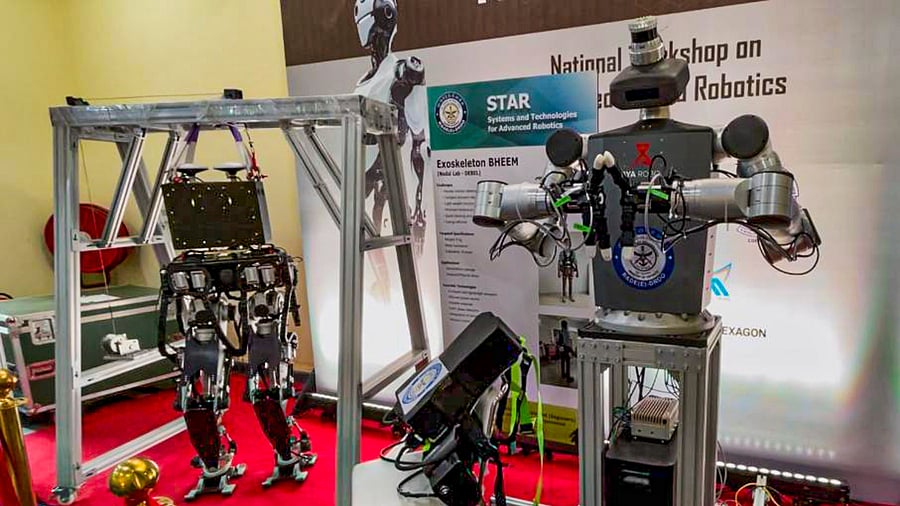
India’s gross expenditure on research and development has remained stagnant at 0.6–0.7% of GDP for over a decade, which is significantly below the global average of 1.8%. In pic, a humanoid robot being developed by DRDO to be part of a frontline military mission, showcased in Pune. Credit: PTI
For close to 25 years, two recurring themes in successive Prime Ministers’ addresses to the Indian Science Congress have been the plan to raise national expenditure on science and technology to 2% of GDP and the commitment to eliminate red tape in science administration. From Atal Bihari Vajpayee to Manmohan Singh to Narendra Modi, all have spoken about these ideas at some point, but on the ground little progress has been made in realising them.
India’s gross expenditure on research and development (GERD) has stagnated for more than a decade, though in absolute terms the expenditure doubled from Rs 60,197 crore in 2010–11 to Rs 1,27,381 crore in 2020–21, according to a Department of Science and Technology report. The doubling, however, doesn’t tell the complete story.
In the same time frame, the GDP increased more than 2.5 times from Rs 77,84,115 crore to Rs 1,98,00,914 crore. Therefore, India’s GERD as a percentage of GDP is stuck at 0.6-0.7% which is below the global average (1.8%) and lower than in technologically advanced countries like the USA, Japan and South Korea.
The country’s research and development (R&D) spending is also lower than in other BRICS nations Brazil (1.2%), Russia (1.1%), China (above 2%) and South Africa (0.8%). Developed countries like the USA, Sweden and Switzerland spend about 2.9%, 3.2% and 3.4%, respectively. Among all nations, Israel spends the most, 4.5%, of its GDP on R&D. India’s per capita GERD of $43 is among the lowest globally even as the country is on course to become the world’s third largest economy.
Among the 12 major central government scientific agencies, the Defence Research and Development Organisation (DRDO) accounts for the largest share of R&D expenditure at around 31%, followed by the Department of Space (18.4%) while the Ministry of New and Renewable Energy that spearheads the solar energy transition receives only around 0.1%.
A crucial contributing factor to India’s low R&D expenditure is relatively low investment by the private sector, which accounted for only around 36% of gross expenditure on R&D in 2020–21, whereas in many countries private sector contributions exceed 70%. In the past, the private sector’s share was even lower.
Historically, developing countries spent less on R&D because priorities such as tackling hunger, controlling disease and improving citizens' quality of life took precedence. Policymakers tended to allocate more resources to these areas rather than to R&D.
India’s story was similar, but with a key difference. In the early years after independence, institutions like the Council of Scientific and Industrial Research (CSIR), Department of Atomic Energy (DAE), Indian Agricultural Research Institute (IARI), DRDO and Bhabha Atomic Research Centre (BARC) were established to encourage basic research and contribute to economic growth. However, in a newly independent nation with a nascent industrial base, strong linkages with industry were not established.
In this context, academia often views industry as an outside contractor, while business houses use research laboratories primarily to test and calibrate equipment or to try out new technologies to see if they are economically viable.
Over the years, industry has not invested sufficiently in R&D or shared the risk, unlike in the USA where major companies like Boeing, Lockheed Martin, Raytheon and General Dynamics are part of research programmes from the R&D stage itself. Many Indian companies argue that R&D agencies offer little benefit to their business, promise much but deliver too little and almost never deliver on time. This has contributed to a lack of trust between academia and industry.
Short-term ties
Insiders point to a weak research culture in the majority of Indian business establishments, with only a few sectors such as chemicals and pharmaceuticals showing stronger engagement. The industry often finds bureaucratic procedures governing R&D too complex for the profit-oriented private sector. As a result, companies prefer short-term ties with academia that avoid risk, or they set up their own units for specific tasks.
A recent study on R&D data of the top 1,000 listed companies offers a snapshot of the current reality. Commissioned by the Office of the Principal Scientific Adviser (PSA), the study includes data from 912 companies that reported their R&D expenditure for two consecutive fiscal years: FY22 and FY23. Of the 70 PSUs and 842 private companies that participated, only about 50% — 36 PSUs and 427 private companies — reported any R&D spending.
Companies in the defence, pharmaceuticals and automobile sectors recorded the highest R&D expenditure as a percentage of turnover, while six sectors, including civil aviation, financial services and e-platform products and services, reported no R&D investment. Although banking, insurance, finance and non-banking financial companies account for a large share of overall corporate turnover, their contribution to R&D spending is negligible. Other sectors with minimal R&D investment include leather and textile, power, oil and natural gas, plastics, and mining and metal extraction.
A closer look shows that the top three sectors are investing more in R&D to maintain their competitive edge and support plans for expanding their market presence.
The top 20 companies account for approximately 71% of the total R&D expenditure, with the top 10 firms contributing 58%. A majority of Indian companies, including many successful ones, remain either outside the R&D ecosystem or on its margins. There are very few industry‑funded PhD programmes outside the Indian Institutes of Technology and similar institutions.
Companies say they need incentives such as tax breaks and financial subsidies to participate in R&D, which would lower the risk factor. They also seek an equivalent of the USA’s Bayh‑Dole Act, which allows contractors to own inventions arising from federally funded research. Under this US law, universities, nonprofits and small businesses can own, patent and commercialise innovations that are then licensed to industry for manufacturing. The PSA report notes this industry demand but stops short of recommending it.
Instead, it recommends standardising the definition of R&D, continuing tax breaks and introducing additional incentives at both the input and output stages, establishing a mandatory R&D web portal and formulating a policy for mandatory disclosure of R&D expenses.
The second part of the wish list — removal of red tape — has also not been met. The new financial rules are the latest example. A few months ago, Union Science Minister Jitendra Singh said in Parliament, “These (fund flow mechanism) transitions during the last three years led to some difficulties in disbursement of grants.” In the Council of Scientific and Industrial Research (CSIR), the non‑payment of royalties in industry‑funded research and consultancies has remained an unresolved issue for years. Mandatory scientific procurement via the government’s e‑marketplace is yet another example of bureaucracy stifling research.
Finally, good‑quality research in laboratories is carried out by motivated young scientists who must be adequately compensated. This is an area where the Indian R&D system has been faltering for years. Fellowships from agencies like DST and University Grants Commission (which offer 11,750 JRF slots each year) often do not reach students on time, with most receiving support intermittently. Moreover, there are several thousand non‑NET scholars pursuing MPhil or PhD programmes. In 2023‑24, the number of such students who did not qualify the National Eligibility Test (NET) but continued their higher studies was 14,829. They receive a monthly stipend of Rs 8,000 and this amount has remained unchanged since 2012.
Without urgent and meaningful reforms to strengthen research funding and streamline bureaucratic obstacles, India risks undermining its innovation potential.