
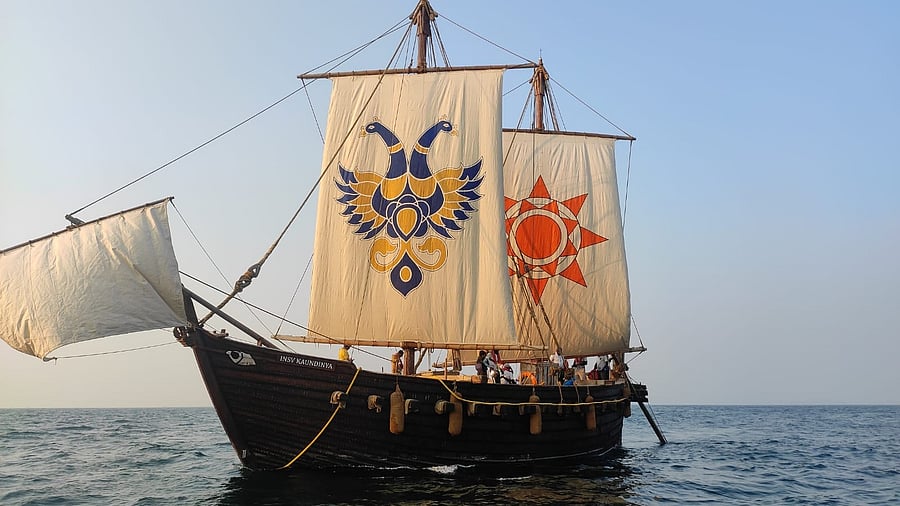
INSV Kaundinya.
Credit: X/ @narendramodi
On Monday (December 29), the Navy’s Indian Naval Sailing Vessel (INSV) Kaundinya embarked on her maiden overseas voyage from Porbandar, Gujarat to Muscat in Oman, reviving India’s ancient seafaring traditions through a ship unlike any modern naval vessel. Built without an engine, metal nails, or modern propulsion systems, Kaundinya relies entirely on wind, sails, and a shipbuilding technique that dates back more than 1,500 years.
INSV Kaundinya is a traditionally built “stitched ship”, a design believed to have been used in India during the 5th century CE. Its form is inspired primarily by depictions of ships in the Ajanta cave paintings, supplemented by references from ancient Indian texts and accounts of foreign travellers. The vessel’s wooden planks are stitched together using coir ropes made from coconut fiber, rather than being fixed with iron nails. Natural resins, cotton, and oils are used to seal the hull, making it seaworthy. Though owned by the Indian Navy, the ship is not a combat vessel.
Prime Minister Narendra Modi also marked the occasion, posting on X that it was “wonderful to see” INSV Kaundinya embark on her maiden voyage. He praised the designers, artisans, shipbuilders, and the Indian Navy for bringing the ancient stitched-ship technique to life, shared images of the vessel and an old mural depicting an ancient ship, and wished the crew a safe journey as they retrace India’s historic links with the Gulf region.
Measuring about 19.6 metres in length and 6.5 metres in width, with a draft of around 3.33 metres, the ship is powered entirely by sails and carries a crew of around 15 sailors. It follows the traditional Tankai method of shipbuilding, in which the hull is stitched first and ribs are added later. This approach gives the structure greater flexibility, allowing it to absorb wave pressure rather than fracture under stress.
The project began in July 2023 under a tripartite agreement between the Ministry of Culture, the Indian Navy, and Hodi Innovations, with funding from the Ministry of Culture. A team of traditional shipwrights from Kerala, led by master craftsman Babu Sankaran, stitched the ship entirely by hand. With no surviving blueprints or physical remains, the Navy extrapolated the design from two-dimensional artistic sources and conducted extensive technical validation, including hydrodynamic studies at IIT Madras.
The vessel was launched at Hodi Shipyard in Goa in February 2025 and formally inducted into the Navy at Karwar, Karnataka, in May. It was flagged off on December 29 by Vice Admiral Krishna Swaminathan in the presence of Oman’s ambassador to India.
The ship carries rich cultural symbolism: Gandabherunda and Sun motifs on the sails, a sculpted Simha Yali on the bow, and a Harappan-style stone anchor on the deck. Named after Kaundinya, a legendary 1st-century Indian mariner associated with the founding of the Funan kingdom in Southeast Asia, the voyage retraces ancient trade routes that once connected India with Oman and beyond—underscoring India’s long-standing maritime legacy and civilisational links across the Indian Ocean.