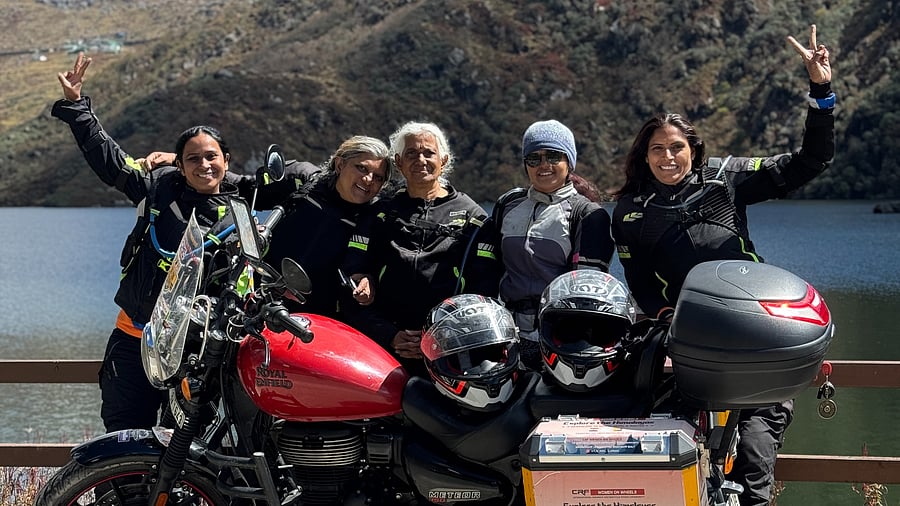
Anitha Karshyap, Seema Warrier, Subhadra Prabhakaran, Sesharani Nagaraj, and Swapna Kumari Kaniti at 12,313 ft Tsomgo Lake in Sikkim.
Credit: Special Arrangement
On September 28, Seema Warrier revved up her bike in Kozhikode and headed towards Bengaluru to meet Anitha Karshyap and Swapna Kumari Kaniti. From there, the three throttled north, riding together all the way to Siliguri in West Bengal. Sesharani Nagaraj flew from Bengaluru into Siliguri after despatching her motorcycle to that city on a train. She was accompanied by the oldest member of the group and the only pillion rider, 77-year-old Subhadra Prabhakaran. Subhadra lives in Hyderabad.
From Siliguri, on October 5, the group set out on what would become the longest and most demanding ride of their lives. They covered 4,000 km during the expedition. It was also their costliest ride, with expenses touching Rs 1 lakh per head.
Those 14 days on the road were marked by unpredictable weather, roads that disappeared under landslides, an accident that got an ambulance rushing to the scene, and an instance of gender discrimination. They woke at 4 am and hit the road by 5 am, stopping every 100 km or so. Riding ended by sunset, and by 10 pm, everyone was in bed.
Yet, as they look back now, the challenges have turned into fond memories. They caught fleeting glimpses of local monasteries, temples and bazaars. The expedition also proved that they could overcome conventional limits of age and gender. For instance, 43-year-old Swapna built her strength and flexibility through a disciplined mix of yoga, walking, and strength training.
Willpower
The expedition was organised under CRF Women on Wheels, an initiative of the Community Riders’ Federation (CRF), based in Kozhikode. It was started in 2016 by Faii Fais, a riding instructor. He began teaching women to ride during a difficult phase in his life. “I was dealing with depression and looking for purpose. Teaching women to ride helped me heal,” he says. The initiative, which is active in six cities in the south, including Bengaluru, has trained women between the ages of 18 and 70.
Initially, it organised short rides within cities, but later shifted gears by launching cross-country expeditions to some of the world’s highest motorable mountain passes in Ladakh. The current expedition was Fais’s idea, and was framed as a challenge for the group. He joined in, riding alongside Seema for a total of 10,000 km from Kerala.
Initial hesitation
Each member of the team found her way to biking differently. Though they all rode scooters, mounting a motorcycle felt like a big leap. It was heavier to handle, and long regarded as a male thing.
For Swapna, an IT professional and emotional healing coach based in Bengaluru, inspiration came at home. Her husband is a biker. “Why am I not trying this out?” she recalls wondering one day. With her husband’s old Yamaha CT 100, she joined CRF last year. “I found it easier to ride with other women. Men ride fast, and it is difficult to keep up,” she says. She began riding long distances only this March. “Highway riding is different from city riding. There are lorries, cattle, and low visibility in the evenings to deal with,” she says.
Though 33-year-old Anitha has been riding for only four years, her love for bikes began in childhood. As a Class 4 student, she would listen, wide-eyed, to her biker neighbour’s tales of road adventures. “I started with a secondhand Xpulse, a popular off-road bike. It was a bit tall, but lightweight enough for me to handle. Now I ride a Gorilla 450 Royal Enfield, a semi off-road bike perfect for mountain trails. It has the same engine as the Himalayan 450. Even though it is heavier (at around 180 kg), riding it is more comfortable, thanks to the lower seat,” says the testing engineer. Today, riding is a passion for her, “an escape from the daily grind”. At the slightest opportunity, she sets off on weeklong trips, exploring far-flung places like Meghalaya.
Seema, a special needs educator, had always admired bikes but never imagined she would ride one. “I would sit on bikes or take pictures whenever I saw them. I even joined a riding school, but nothing came of it,” recalls the 53-year-old. During the Covid-19 lockdown, watching one of her friend’s riding videos on social media rekindled her interest, and she discussed it with her husband. They faced resistance from some quarters, with people suggesting it would be wiser to invest in a car than a bike. But her husband stood firmly by her. They zeroed in on a Royal Enfield Meteor 350, which arrived just before her 49th birthday. She fondly calls it Pumpkin.
Subhadra is Seema’s mother. She was initially hesitant about a long ride across changing terrains in uncertain weather conditions. “Seema took me on a short ride around Hyderabad, and I saw up close her love for biking. Then she simply asked, ‘Amma, come on the expedition. I will take you as a pillion’. My husband encouraged me to go with her,” she recalls.
At 31, Sesharani Nagaraj was the youngest in this intergenerational group. An IT professional in Bengaluru, her journey into motorcycling began by circumstance. She used to travel as a pillion with friends and family, but when the pandemic disrupted that routine and friends moved to other cities after getting married, she realised she needed to be independent.
She and her brother bought a bike. He encouraged her to learn, giving her the option to sell it if it did not work out. By then, she had obtained a driving licence and enrolled in riding classes.
Convincing families
Despite years of biking experience, the women confronted many concerns before the expedition.
“My husband and son were supportive, but my parents would say, ‘You are already riding to the office. So why do you want to go on highways? It could be dangerous. And how will your son manage without you?’” recalls Swapna. Convincing them took time, and eventually, Nihal, her son, went to stay with his grandparents. “Parents will always worry, no matter how old you are,” she says.
Anitha’s family did not know about her biking escapades until she bought a new, expensive bike for the expedition. They argued that the money would have been better spent on her daughter’s education. But they also came around. “My daughter stays mostly with my parents during holidays. That’s how I find time for long rides,” she says.
Sesharani’s family was primarily worried for her safety. But once they learned about her training and the plan, they were fully on board with the idea.
On Subhadra’s side, relatives voiced their scepticism, warning her “You shouldn’t go. You will suffer.” But Seema, her younger daughter, and her husband were steadfast
in their support. “I have been practising yoga since 2000, and do pranayama and sudarshan kriya. I knew my health was fine,” she explains.
Seema was fortunate to have the full support of her immediate family. Before this expedition, her bike, Pumpkin, had already woven through almost every state of India, except those in the north-east. “My first long ride was from Kozhikode to Coimbatore, with my husband as pillion. He does not ride anymore due to an injury. We once went to Goa and extended the ride to Mumbai, and we also completed the mini K2K circuit from Kasaragod to Kanyakumari. I did my first long solo ride from Thiruvananthapuram to Kozhikode,” she recalls. During these trips, she had two falls that required surgeries, but they taught her to travel lighter and ride more mindfully.
Busting a common misconception, the team says male bikers are overwhelmingly supportive of female bikers. They have met men who stop to check on them or guide them through the route. They share tips on local food and swap notes on bike specs. “There’s a real sense of solidarity in the biking community. Men see us as fellow riders, not just female riders,” says Swapna.
No hotels for women
No plan is foolproof on offbeat trips, they quickly found out. They were off-roading right from the start of the expedition.
The 112 km stretch from Siliguri to Gangtok in Sikkim was slowed down by a landslide. What normally took four hours stretched to 11. “It was tedious. Seema and I even fell off the bike. After that, Fais took me pillion. I didn’t get hurt. I actually enjoyed falling!” says Subhadra. In comparison, the group covered 500-600 km on smoother days.
Landslides and weather disruptions also blocked key routes into Nepal, forcing the group onto a muddy track carved by trucks. “On one side we had the mountain, on the other the river. The road was narrow, and vehicles passed on both sides,” she recalls.
“The Nepal section tested my patience. It was almost 50 km of off-roading. I nearly gave up, but the group kept me motivated,” says Swapna.
There were stretches when Anitha’s bike ran out of petrol, and she had to borrow some from Swapna. One time, a glitch forced her to shift to first gear and carefully ease her way downhill. Fais’s bike also suffered from overheating.
Travel demands flexibility — and they shortened their Bhutan leg by a day to save costs. “We had planned four days there, but permits for our bikes and ourselves for that period were coming to around Rs 24,000 per head,” says Swapna.
However, their biggest shock came in Odisha, where at least three hotels refused them rooms because they were women. “This was around 11 pm. The first manager denied us rooms, even after we showed our IDs, explained that we were on a biking expedition, and said even two rooms would be enough,” Anitha says. So they were forced to ride straight to Bhubaneswar. Anitha had another frightening moment in Odisha. She blacked out for 30 minutes after braking suddenly to avoid slamming into a dead cow. “When I woke up, there was an ambulance. I thought, why am I here? But the doctor said I was fine to continue riding,” she recalls.
Food posed a challenge for Subhadra. She was not used to eating instant noodles but but had to make do with them and momos while on the road. “That was my first time tasting momos,” she says.
Despite the hurdles, camaraderie carried them through. Seema says it helped them manage disagreements and navigate routes effectively. Anitha adds, “On the road, we only have each other. When I was tired, Swapna or Seema would encourage me to nap, or we would stop for coffee. Keeping our energy levels equal was important.”
Ready for more
Despite the setbacks, there were innumerable moments of beauty and wonder.
On the way to Zero Point (a high-altitude Himalayan stretch in north Sikkim near the China border), tourists urged them to hurry, warning that rain could close the entry. “Fais encouraged us to keep going. As we reached, it started snowing. I always thought I would have to go to Kashmir to see snowfall, but here I was, experiencing my first snowfall. It was magical,” recalls Swapna. Even Subhadra, who had seen snow in Japan and Russia, was enchanted by the white scenery. “There was fresh, fluffy snow everywhere. We played like children,” she says. Sesharani gets poetic: “Travelling by car is like watching a movie, but on a bike, you become part of it, as one of its characters. Riding makes you one with the environment.”
They turned even routine moments into memories. They chatted over their helmet-mounted Bluetooth systems, shared playlists, and checked if anyone was dozing off. “Sometimes we would start singing together while riding. I was the worst singer. My rendition of ‘Chalte chalte mere yeh geet yaad rakhna’ sure kept everyone wide awake,” Swapna says, laughing.
Subhadra’s presence drew curiosity wherever they went. “In Bhutan, we ran into tourists from Kerala. They were thrilled to see me and took pictures,” she says. The septuagenarian’s energy and discipline was inspiring. “Before we even opened our eyes, she was ready for the day — gear on, equipment packed. She handled zero-degree temperatures with ease,” adds Sesharani.
The women have returned with a greater thirst for adventure. Some were on other biking trips already when we contacted them for this story last week. “I believe everyone needs to step outside their comfort zone and truly experience life,” says Subhadra.
Like this story? Email: dhonsat@deccanherald.co.in