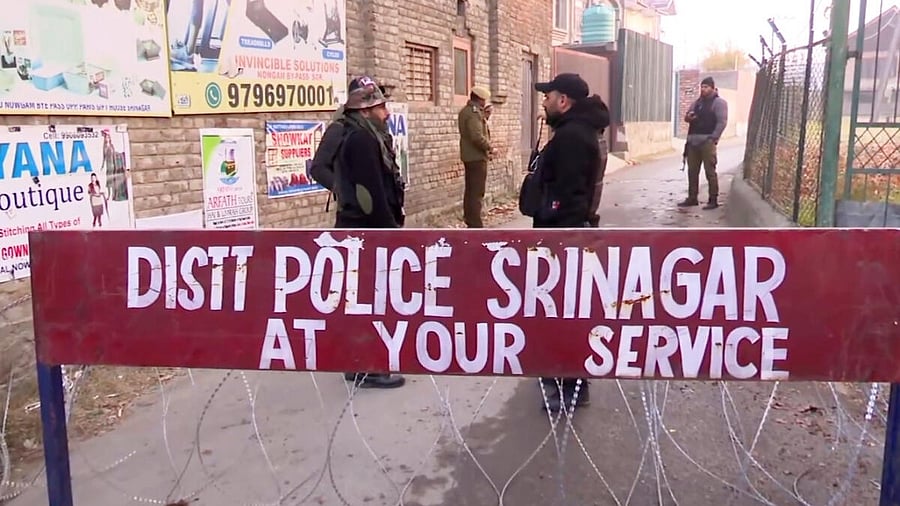
Security personnel keep vigil after an accidental explosion ripped through Nowgam police station on late Friday night, in Srinagar.
Credit: PTI photo
Srinagar: A powerful late-night explosion inside Nowgam Police Station on the outskirts of Srinagar killed nine people and left more than 30 injured, after a stockpile of seized explosives linked to the Faridabad “white-collar” terror module accidentally detonated during forensic handling, officials said on Saturday.
The blast, which tore through the police compound around 11:20 pm, was so intense that body parts were flung 100–300 metres away into surrounding residential areas, and the station building was “very severely damaged,” according to rescue officials and CCTV footage reviewed by investigators .
Jammu & Kashmir police chief Nalin Prabhat ruled out any terror angle, calling the explosion a “tragic accident” that occurred when a forensic team was sampling “volatile, sensitive explosive material” stored in the police station’s open yard.
The Ministry of Home Affairs (MHA), too, said the detonation resulted from the unstable nature of the stored explosives, dismissing speculation of foul play and stressing that the material had been kept following standard procedures for seized substances.
Among the nine killed were three FSL personnel, two revenue officials including Naib Tehsildar, a police photographer, an SIA officer, and a local tailor who happened to be in the station on official work at the time . At least 32 others sustained injuries of varying severity, most of them policemen and forensic staff, who were rushed to the Army’s 92 Base Hospital and SMHS Hospital in Srinagar.
Relatives of the civilian victim, the tailor, staged protests on Saturday, demanding to know why a non-police worker had been allowed inside a facility handling such volatile material .
Officials confirmed that the explosives were part of a 360 kg ammonium nitrate-based cache seized from a rented accommodation in Faridabad during the recent crackdown on a suspected “white-collar” terror module. The same module is being probed for its alleged links to the Hyundai i20 car blast near Delhi’s Red Fort, which killed at least 10 people last week.
Investigators say the Faridabad seizure is also connected to the broader probe into a 2,900 kg ammonium nitrate haul recovered earlier from the Delhi–NCR region.
The suspected links of the module to radicalised professionals, including doctors, have widened the investigation in recent days, with multiple detentions and digital device seizures reported from Kashmir.
CCTV visuals from the compound captured a sudden flash, followed by a massive fireball and secondary explosions, which forced bomb disposal teams to delay entry for several minutes due to the risk of further detonations.
Senior officers inspecting the site early Saturday said the blast left a deep crater in the yard where the explosives had been stored. Nearby homes suffered blown-out windows, collapsed tin roofs and debris damage.
A detailed inquiry into whether safety protocols were followed, especially while handling material known to be highly unstable, has been ordered. Jammu and Kashmir Lieutenant Governor Manoj Sinha had ordered a probe into the incident. “I have ordered a probe to ascertain the cause of the accidental explosion,” Sinha said in a post on X.
Opposition leaders have demanded accountability, with several calling for an independent probe. Online outrage intensified after local residents posted images of mangled vehicles and debris scattered across the neighbourhood.
Officials described the tragedy as a cruel twist in a terror investigation already under national scrutiny — the very explosives recovered to avert an attack ending up causing one of the deadliest police-station accidents in Kashmir in years.