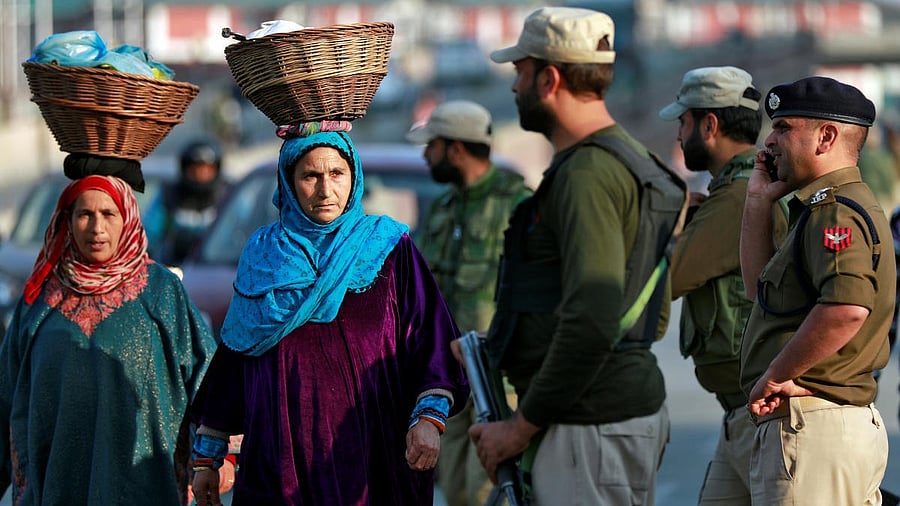
Image of Kashmiri women for representational purposes.
Credit: Reuters Photo
Srinagar: High in the Pir Panjal mountains, the air is thin, the terrain rugged, and the journey long.
For the nomadic Gujjar and Bakarwal communities, the biennial migration from the lowlands of Rajouri and Poonch to the high pastures of the Kashmir Valley is a way of life—but for pregnant women, it is a perilous ordeal.
Carrying heavy loads, enduring long hours on foot or horseback, often without enough food or water, many go into labour far from the nearest hospital, relying only on family members or elderly midwives. Some survive against the odds; others die quietly along the forested trails, their struggles largely invisible to the world.
24-year-old Rabia, in the final weeks of her pregnancy, felt labour pains halfway through the spring trek. With no clinic in sight and no way to call for help, she was attended only by her mother and an experienced midwife, Nargis, who has delivered dozens of babies along the migration route.
Hours later, Rabia gave birth beside a small tent pitched near a forest stream. Weak and bleeding, she had no choice but to continue the arduous journey on horseback, her newborn tied carefully to her side.
Life along the migration path is unforgiving. Babies are born beneath trees, by riverbanks, or in makeshift shelters, often on wet or uneven ground. Pregnant women carry supplies, water, and even their younger children while walking or riding long distances. Many go days without a proper meal.
Early marriage and chronic malnutrition further increase the risks. Farah, married at 16, recalls giving birth at 17 after weeks on minimal rations; by the time she reached the nearest hospital, she was severely anaemic and required urgent medical intervention.
Traditional midwives like Nargis are the community’s lifeline. “Sometimes there is so much blood loss or infection that we cannot save the mother,” she says, recalling women who died high in the hills because the nearest hospital was too far, or food and water were exhausted.
Most deaths go unrecorded, as official statistics only reflect hospital deliveries, leaving the experiences of women on migration routes invisible.
Healthcare outreach is limited and sporadic. Mobile units and government promises often fail to reach these high pastures due to the challenging terrain, limited staffing, and insufficient funding.
Doctors familiar with these migration routes say the risks are enormous. “Many women begin labour miles from any health facility. By the time they reach the hospital, they are often exhausted, severely anaemic, or suffering from complications that could have been prevented with timely care,” says Dr. Mushtaq, a public health specialist who has accompanied health teams on the way to these high pastures. “We see women giving birth on horseback or beside a stream—sometimes they make it, sometimes they don’t.”
Globally, pastoralist women face similar challenges. Mobile clinics in Mongolia, Ethiopia, and Somalia provide antenatal care, immunisation, nutrition services, and emergency support to women far from conventional healthcare. In Kashmir, however, these services remain limited.
For Gujjar and Bakarwal women, giving birth along the migration route is a mixture of courage, tradition, and sheer luck. “In these mountains, what else can they rely on, if not an old woman’s hands?” asks Nargis, folding her blankets after another delivery. The forest gives life, but it can also take it.
Every season, mothers and babies traverse treacherous terrain far from modern medicine, carrying with them a legacy of survival—and risk—that continues to define life in the high meadows of Kashmir.