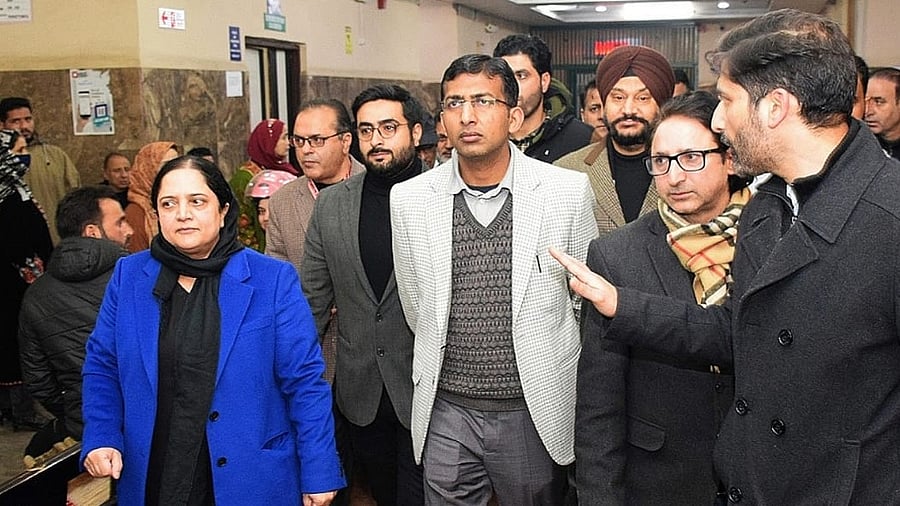
Anshul Garg, Divisional Commissioner, Kashmir, who was the chief guest at the event, underlined the policy rationale behind the initiative.
Credit: X/ @ddprsrinagar
Srinagar: As India confronts a deepening drug crisis that stretches from border states to metropolitan centres, the Jammu and Kashmir administration has begun testing an unconventional policy response — integrating faith leaders into its public health strategy to tackle substance abuse.
This weekend, the J&K administration brought together over 100 masjid imams and religious scholars at Institute of Mental Health and Neurosciences (IMHANS), Government Medical College, Srinagar, signalling a shift away from purely enforcement-driven approaches towards community-anchored prevention and early intervention.
The initiative comes amid growing recognition that stigma, fear and social denial continue to block access to treatment across the country.
India’s challenge is stark. According to a nationwide survey, an estimated 3.1 crore people use drugs ranging from opioids and cannabis to synthetic substances, yet fewer than 5% receive any form of treatment. Experts say this treatment gap — driven largely by stigma and lack of awareness — has blunted the impact of policing and de-addiction infrastructure.
Jammu and Kashmir mirrors this national pattern with added urgency. Government data suggests that around 10% of the Union Territory’s population uses psychoactive substances, including a worrying number of adolescents. Officials say the problem has spread beyond marginalised groups into schools, colleges and workplaces, forcing policymakers to look beyond conventional tools.
The orientation and capacity-building programme, held at the IMHANS, sought to equip imams with a basic understanding of substance use disorders, referral pathways and rehabilitation services. Importantly, the discussions also explored Quranic guidance and the Islamic perspective on addiction, emphasising compassion, responsibility and rehabilitation rather than punishment.
Participants agreed that masjids and Friday sermons offer a powerful platform to reach families and individuals who often retreat into silence and denial. By addressing addiction from the pulpit, religious leaders said they could help break the psychological and social isolation that prevents early help-seeking.
Senior officials and doctors briefed the religious leaders about their role in reducing stigma and encouraging people with addiction disorders to seek medical help instead of hiding their condition.
Addressing the gathering, Dr Arshad Hussain, Head of the Department of Psychiatry at IMHANS, highlighted the growing burden of substance use disorders in the region. He stressed that early intervention and community participation were essential to prevent long-term health and social damage.
“Addiction is a medical condition. Communities play a decisive role in identifying it early and guiding people towards treatment,” Dr Hussain said.
Anshul Garg, Divisional Commissioner, Kashmir, who was the chief guest at the event, underlined the policy rationale behind the initiative. “Religious scholars are key to raising awareness, reducing stigma, and encouraging early help-seeking,” he said.
Officials said plans are to see if the programme can be replicated across districts, with outcomes closely monitored. While its long-term impact remains to be seen, the experiment reflects a broader national shift — an acknowledgment that India’s drug crisis cannot be solved by the state alone.
For policymakers beyond Kashmir, the message is clear: when public health strategies engage institutions people trust, solutions can travel far deeper than any enforcement drive.