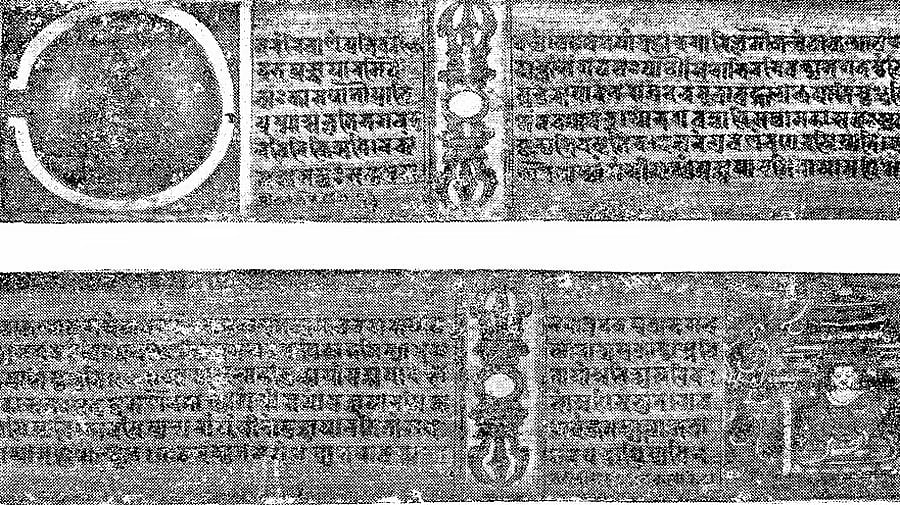
Representative image of manuscripts.
Credit: iStock Photo
Srinagar: From fragile Sharda texts to centuries-old Persian manuscripts, thousands of handwritten works preserved across Jammu and Kashmir will now be digitally archived as part of a national initiative to safeguard India’s civilisational knowledge.
The Government of India has designated the Persian Department of the University of Kashmir (KU) as a cluster centre under the Gyan Bharatam Mission, a flagship initiative of the Ministry of Culture to survey, conserve and digitise the country’s vast manuscript heritage.
Dr Jahangir Iqbal, Head of KU’s Persian Department, has been appointed Coordinator and Cluster Head for Jammu and Kashmir under the mission. A MoU formalising this was signed on October 25 last year in New Delhi in the presence of Union Culture Minister Gajendra Singh Shekhawat.
The department was selected based on its long-standing track record in UGC and National Mission for Manuscripts projects and for housing a recognised Manuscripts Resource Centre.
The cluster centre has been entrusted with a five-year mandate to identify, document, preserve and digitise manuscripts in Sharda, Sanskrit, Persian and Arabic scripts held by government and semi-government bodies, temple committees, Gurudwaras, Khanqahs, trusts, NGOs and private custodians across Jammu and Kashmir. The department also runs a dedicated research and publication wing, which has critically edited and published several rare texts.
Announced in the Union Budget 2025–26, the Gyan Bharatam Mission aims to create a National Digital Repository of Manuscripts, making rare and fragile texts accessible to scholars, students and the public. The initiative expands on the earlier National Mission for Manuscripts with greater funding, institutional participation and modern digital tools, including AI-assisted cataloguing and transcription.
Jammu and Kashmir represents a particularly rich manuscript heritage, especially in Persian and Sharda scripts that flourished for centuries. Many manuscripts are vulnerable due to age, poor storage and damage caused by the 2014 floods, which destroyed or damaged a significant number of rare texts. Estimates indicate that India possesses over one crore manuscripts covering subjects ranging from philosophy and literature to science, medicine, astronomy, law and religion.
Under the MoU, sub-centres will be set up in Jammu and other parts of the Valley to carry out systematic registration, conservation and preservation. Over the next five years, manuscripts from government, semi-government, temple and private collections will be catalogued, conserved and digitised following the guidelines of Gyan Bharatam, enabling wider public access and long-term preservation of India’s diverse manuscript heritage.