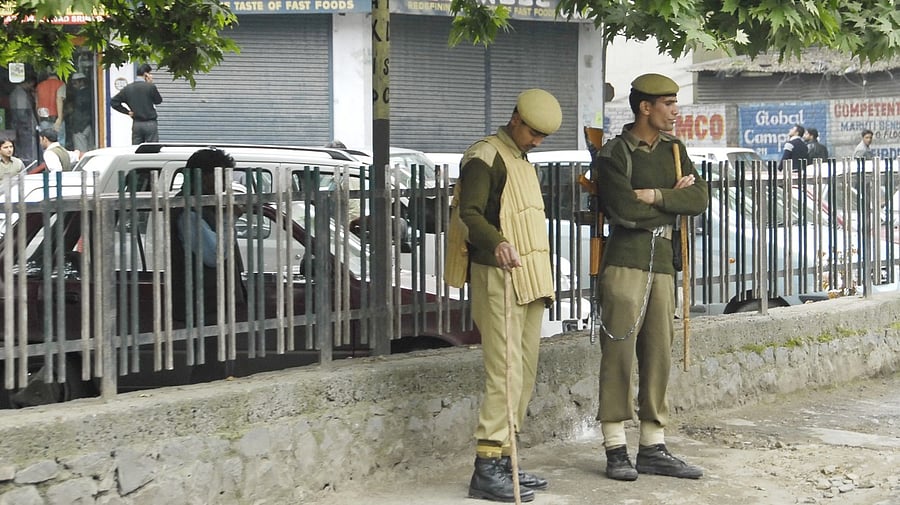
Representative image of policemen
Credit: iStock Photo
Srinagar: A police-led data collection drive across Kashmir seeking detailed information on mosques, seminaries and religious functionaries has triggered political and religious backlash. Srinagar-based newspapers report that a detailed proforma has been circulated through village heads and Revenue Department employees to gather information on mosques, clerics, religious teachers and members of management committees.
The proforma also seeks details about the school of thought followed by each mosque or seminary as per Islamic jurisprudence, intensifying concerns about ideological scrutiny rather than routine administrative mapping.
What is the official rationale?
Police authorities have not issued a detailed public explanation. Officials familiar with such exercises say they are justified as preventive security measures aimed at monitoring radicalisation, preventing misuse of religious platforms and maintaining public order. Critics argue that the absence of a clearly articulated legal framework or safeguards has made the exercise appear opaque, particularly given the depth of information sought.
Why has it drawn objections?
The controversy centres on the perception of selective surveillance and intrusion into religious affairs. Political parties and religious groups argue that the exercise focuses exclusively on Muslim religious institutions, creating an impression of collective suspicion. Former Chief Minister and PDP president Mehbooba Mufti has described the profiling of mosques and imams as direct interference in religious life, warning that such measures risk alienating Muslims from both their faith and the state.
What has ruling NC said?
The National Conference (NC) has expressed serious concern, terming the exercise a gross and unwarranted interference in the religious affairs of the Muslim community. In a statement, party spokesperson Imran Nabi Dar said the exercise violates fundamental rights, including the right to privacy and protection of personal information guaranteed under the Constitution.
What do religious bodies say?
The Muttahida Majlis-e-Ulema, Kashmir’s leading amalgam of Islamic organisations, described the exercise as a complete violation of fundamental rights. It said internal religious affairs cannot be subjected to arbitrary surveillance and warned that the nature and depth of information being sought goes far beyond routine administrative requirements, raising serious questions about intent.
Kashmir’s chief cleric, Mirwaiz Umar Farooq, called on the elected government to intervene and halt the exercise. “Such an exercise must be stopped forthwith. It undermines trust, creates fear among religious functionaries and telegraphs a disturbing message to the entire Muslim community,” he said, adding that discriminatory scrutiny of mosques and religious personnel is counterproductive and harmful to social harmony.
How is this seen in the post-Article 370 context?
Since the abrogation of Article 370 in August 2019, the Union government and security establishment have repeatedly highlighted “outreach” initiatives aimed at integrating Kashmir more closely with national institutions. These have included engagement with community elders, religious leaders and civil society groups.
However, in Kashmir, many such measures have been viewed with scepticism, particularly when they are accompanied by expanded surveillance, administrative control and restrictions on political activity. Critics argue that outreach perceived as security-driven rather than consultative tends to deepen mistrust, especially when it involves religious institutions that traditionally function independently of the state.
Legal experts point out that after the Supreme Court recognised privacy as a fundamental right, any state collection of personal or institutional data must meet tests of legality, necessity and proportionality. Critics argue that seeking doctrinal details of mosques risks violating both the right to privacy under Article 21 and the freedom of religion guaranteed under Article 25.
Why does it matter?
While security agencies maintain that monitoring religious spaces is necessary in Kashmir’s sensitive context, opponents warn that blanket profiling without transparency risks criminalising religious leadership and eroding public trust. The controversy has thus become part of a broader debate on how security, governance and civil liberties intersect in post-Article 370 Jammu and Kashmir.