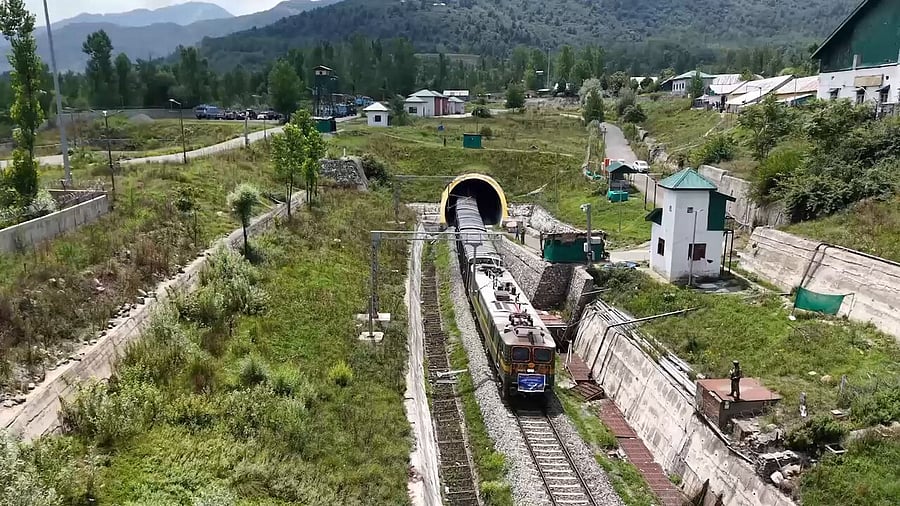
Divisional Manager, FCI Kashmir, K L Mina said the train from Punjab carried around 1,384 metric tonnes of foodgrains in 21 wagons.
Credit: X/@AshwiniVaishnaw
Srinagar: The first-ever foodgrain freight train of the Food Corporation of India (FCI) reached the Anantnag Goods Terminal on Sunday, providing Kashmir with an additional supply route for essential commodities as frequent winter closures of the Srinagar–Jammu National Highway continue to disrupt road transport.
The arrival of the civilian freight train comes days after the Army transported tanks and artillery guns to Kashmir through a Military Special Train, underscoring the increasing use of the rail network for logistics in the Valley.
Divisional Manager, FCI Kashmir, K L Mina said the train from Punjab carried around 1,384 metric tonnes of foodgrains in 21 wagons.
“21 wagons have arrived today and another 42 will arrive soon. Around 1,300 metric tonnes of rice have arrived today, while the remaining wagons will bring about 2,600 metric tonnes, equivalent to nearly 110 truckloads,” Mina said.
Kashmir’s supply of essential commodities has long depended on the Srinagar–Jammu National Highway, the Valley’s only all-weather road link with the rest of the country.
During winter months, the highway is frequently closed due to heavy snowfall, avalanches, landslides and shooting stones, at times remaining shut for several days.
These disruptions often delay the movement of foodgrains, fuel and medicines, affecting both government supplies and private markets.
Prolonged closures of the highway have in the past forced the administration to rely on limited airlifting of essential items, an expensive option that cannot meet bulk demand.
Long queues of trucks stranded on either side of the highway are common during winter, leading to delays in supplies under the Public Distribution System (PDS) and price fluctuations in local markets.
Officials said rail-based movement of foodgrains could help reduce dependence on the highway during such periods. Mina said that earlier transportation of foodgrains from Punjab took considerably more time and involved higher costs.
“Rail transport saves time and resources and improves logistical efficiency,” he said.
The freight movement also follows the inauguration of the long-awaited railway line to Kashmir earlier this year by Prime Minister Narendra Modi, which provided direct rail connectivity to the Valley.
While passenger services are still being stabilised, officials said the movement of defence equipment and food grains indicates the railway’s potential as a supplementary supply corridor.
Traders and officials cautioned that the railway cannot replace road transport entirely, but said it could serve as a critical alternative during prolonged winter disruptions.
“The railway offers a backup option when road connectivity becomes unreliable,” a senior official said.