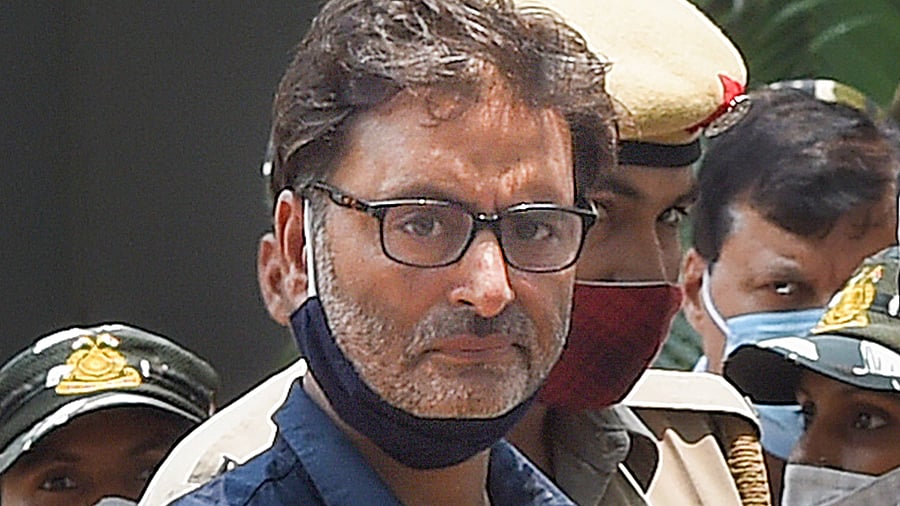
JKLF chief Yasin Malik.
Credit: PTI File Photo
Srinagar: Few individuals embody Kashmir’s turbulent political journey as starkly as Yasin Malik. Once a gun-wielding militant, later a self-styled Gandhian separatist, Malik today sits in Delhi’s Tihar Jail, serving multiple life sentences in a terror-funding case. His trajectory mirrors the Valley’s own arc — from rage and rebellion to fatigue and legal closure.
1987: The election that broke faith
Born in 1966 in Srinagar, Malik entered politics during the 1987 Jammu and Kashmir Assembly elections, widely believed to have been manipulated to block pro-separatist candidates. Malik worked as a polling agent for Syed Salahuddin, who would later head Kashmir’s largest indigenous militant group Hizbul Mujahideen.
For many young Kashmiris, that election marked the end of faith in democratic politics. For Malik, it proved decisive.
Picking up arms: JKLF and the insurgency
By the late 1980s, Malik had joined the Jammu and Kashmir Liberation Front (JKLF) — a group advocating independence for Kashmir, distinct from Pakistan-backed Islamist outfits. JKLF projected itself as secular and nationalist but embraced armed struggle.
Malik crossed into Pakistan-occupied-Kashmir for training and returned as a militant leader. JKLF was among the first groups to challenge the Indian state militarily.
The insurgency’s most dramatic early episode came in December 1989, when JKLF militants kidnapped Rubaiya Sayeed, daughter of then Union Home Minister Mufti Mohammad Sayeed. She was released after the government freed jailed militants — a moment that emboldened insurgents and exposed state vulnerability.
In 1990, as violence engulfed the Valley and large numbers of Kashmiri Pandits fled, Malik was arrested.
The pivot: Renouncing violence
Then came a dramatic turn. In 1994, Malik publicly renounced armed struggle, announcing a unilateral ceasefire by his JKLF faction. He later claimed Indian civil society interlocutors had assured him that peaceful political activity would be allowed if he gave up violence.
The Indian state appeared to accept the gamble. Malik was released, and for nearly two decades he operated openly — organising rallies, giving interviews, and positioning himself as the face of non-violent separatism.
Critics called it indulgence. Supporters called it accommodation.
Politics by march and slogan
Malik’s most visible campaign was “Safar-e-Azadi” (Journey of Freedom) in 2007, during which he travelled across Kashmir’s towns and villages, mobilising opinion through meetings and signature drives.
Yet his non-violent image was repeatedly punctured — notably by appearances alongside Pakistan-based jihadist leaders at events abroad, reinforcing security agencies’ claims that separatist politics and militancy were never fully separate.
2017–19: The crackdown
After the killing of militant commander Burhan Wani in 2016 and months of violent protests, the state’s posture hardened.
In 2017, the National Investigation Agency (NIA) registered a terror-funding case, alleging that Malik and other separatist leaders had received funds from across the border to fuel unrest, stone-pelting and shutdowns. In 2019, Malik was arrested by the NIA. This time, there was no political middle ground.
A guilty plea and life sentences
In May 2022, Malik shocked observers by pleading guilty to charges under the Unlawful Activities (Prevention) Act, including terror funding, criminal conspiracy and waging war against the state.
The NIA sought the death penalty, citing his militant past. The court declined, ruling that while the crimes were grave, they did not meet the “rarest of rare” threshold. Malik was sentenced to multiple life terms and heavy fines. He remains in Tihar Jail.
Will he be hanged?
As of now, no. There is no death sentence against Malik. While the NIA has appealed for a harsher punishment, Indian courts are cautious with capital punishment, reserving it for exceptional cases. Any move towards execution would require higher courts to overturn the trial court’s reasoning — a difficult legal climb.
Old cases, unresolved questions
Meanwhile, decades-old cases have resurfaced, including the 1989 Rubaiya Sayeed kidnapping, where witnesses have identified Malik long after the event. Testimony has also linked him to the 1990 killing of Indian Air Force personnel.
They revive a question that refuses to go away: Does renouncing violence erase responsibility for past acts?
Why Malik still matters
Malik’s conviction signals the end of the separatist era built on street mobilisation rather than arms. For the Indian state, it marks a decisive break from political tolerance. For Kashmir, it closes a chapter — not with reconciliation, but with incarceration.
The guns fell silent years ago. The reckoning arrived much later.